Thermal diffusivity
Check diffusivity to review the measured heat-spread response from a flash method report, especially when the procurement keyword is synthetic graphite thermal diffusivity testing.

Views: 0 Author: Site Editor Publish Time: 2026-11-12 Origin: Site


For synthetic graphite thermal diffusivity testing, do not compare a single headline conductivity value until the report also states the measured thermal diffusivity, density, specific heat capacity, test temperature, material direction, and calculation assumptions.

In a report, diffusivity describes how quickly a temperature change moves through a material, while conductivity is often derived in many cases from diffusivity together with density and specific heat capacity.
Check diffusivity to review the measured heat-spread response from a flash method report, especially when the procurement keyword is synthetic graphite thermal diffusivity testing.
Use conductivity as a derived or reported heat-transfer property only after confirming the density, specific heat capacity, temperature, and direction behind the value.
| Procurement field | Diffusivity question | Conductivity question |
|---|---|---|
| Input basis | Confirm whether thermal diffusivity was measured by the stated method. | Was conductivity calculated from diffusivity, density, and specific heat capacity, or measured another way? |
| Review risk | A diffusivity value alone does not show the full conductivity basis. | A conductivity value without input data is difficult to compare across reports. |
| Metrology context | Use thermophysical-property terminology consistently, but do not treat gas-mixture literature as graphite product evidence. | Use that grouping as terminology context, not as graphite product evidence. |
Ask for the raw diffusivity result, density, specific heat capacity, temperature, test direction, sample description, and the equation or model used to turn test data into a conductivity number.
For graphite foils and layered carbon materials, the report direction matters because in- and through- measurements can represent different heat-flow paths and different model assumptions.
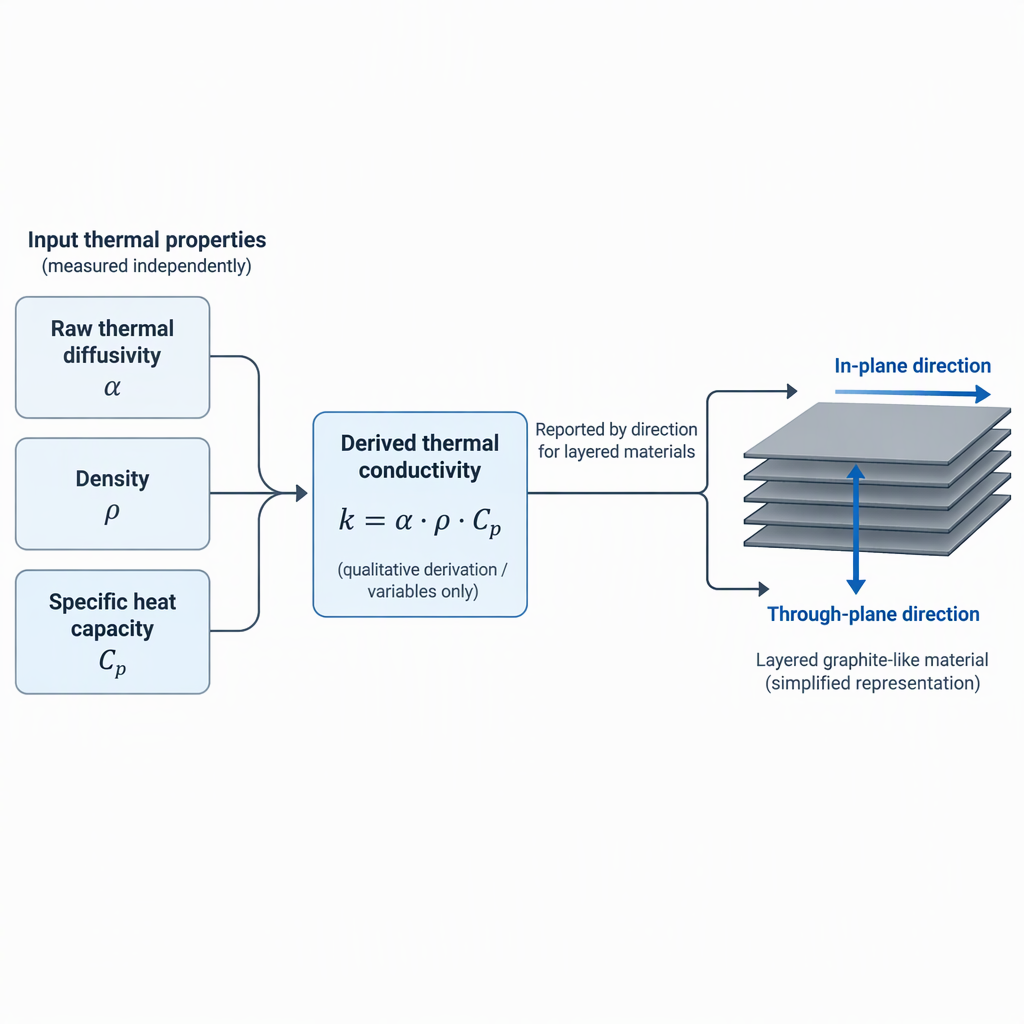
| Report label | What buyer should confirm | Why it matters |
|---|---|---|
| In- | Confirm the holder, orientation, and model used for heat flow along the . | Layered carbon research illustrates separate in- diffusivity and conductivity determination. |
| Through- | Confirm the sample stack, thickness direction, and calculation model. | Through- values answer a different heat-flow question from in- values. |
| Unlabeled direction | Treat the value as incomplete for comparison until the laboratory states the direction and model. | Direction-dependent diffusivity requires direction-specific reporting in anisotropic graphite measurement contexts. |
ASTM E1461 is useful for anchoring flash-method thermal diffusivity language, but procurement reviewers should not treat the public scope as a complete answer for anisotropic in- graphite reporting.
Supplier quality should block comparisons that mix direction, temperature, method basis, or derived and measured values without explanation.
| Question | Acceptable buyer action | Evidence basis |
|---|---|---|
| Is the value diffusivity or conductivity? | Compare only the same metric, or request the inputs used to derive conductivity. | Conductivity may be derived from diffusivity, density, and specific heat capacity in many cases. |
| Is the direction in- or through-? | Separate the comparison by direction instead of ranking one mixed list. | Graphite foil measurement can require direction-specific holders or models. |
| Does the report state temperature? | Request the test temperature before approving equivalence. | Report values are method- and condition-dependent. |
| Is a benchmark sheet being used? | Use a Jones Tech specification sheet, or any 2023 benchmark sheet, as a format reference only unless your team has the same metric, direction, temperature, and method basis for both suppliers. | Procurement control |
A strong RFQ asks for raw data fields and labels before it asks the supplier to summarize performance in one number.
A higher reported value is not automatically a better procurement choice when the compared reports use different metrics, directions, temperatures, or calculation inputs.
Approve a synthetic graphite thermal report only after the metric, inputs, direction, temperature, method reference, and model assumptions are clear enough for like-for-like comparison.
| If the report lacks… | Do this before approval |
|---|---|
| Density or specific heat capacity behind derived conductivity | Request the missing inputs and calculation basis. |
| Direction label | Ask whether the value is in- or through- before comparing suppliers. |
| Method and temperature context | Hold the comparison until the laboratory supplies the missing conditions. |
The practical rule is simple: compare synthetic graphite thermal reports only after the metric, raw inputs, direction, temperature, and method assumptions are aligned.
For materials engineers and supplier-quality teams, the safest procurement comparison is not the largest number on the page; it is the number whose basis can be traced to the same heat-flow direction and the same calculation logic.
These answers help reviewers turn thermal-property terminology into practical report checks.
No. Treat diffusivity and conductivity as related but different values; conductivity may depend on diffusivity, density, and specific heat capacity in many cases.
Raw diffusivity, density, and specific heat capacity let your team check the basis of a derived conductivity value instead of accepting an unsupported summary number.
Graphite foil measurement can be direction-dependent, so in- and through- values may describe different heat-flow paths.
Yes, it can anchor flash-method thermal diffusivity language, but ask the laboratory to explain sample-specific orientation and model choices when the graphite is anisotropic.
Not automatically. First confirm that the reports compare the same metric, direction, temperature, and calculation basis.
Use any benchmark sheet as a checklist for fields to request. Do not treat it as proof of equivalence unless the supplier report matches the same metric, direction, temperature, and method basis.
They are important when conductivity is derived from diffusivity, because those inputs affect the calculation basis.


