
Views: 0 Author: Site Editor Publish Time: 2026-11-27 Origin: Site


A polyimide-derived synthetic graphite film label tells buyers the likely precursor and heat-treatment route, but it does not by itself prove thermal performance, thickness tolerance, compliance, application fit or supplier capability.
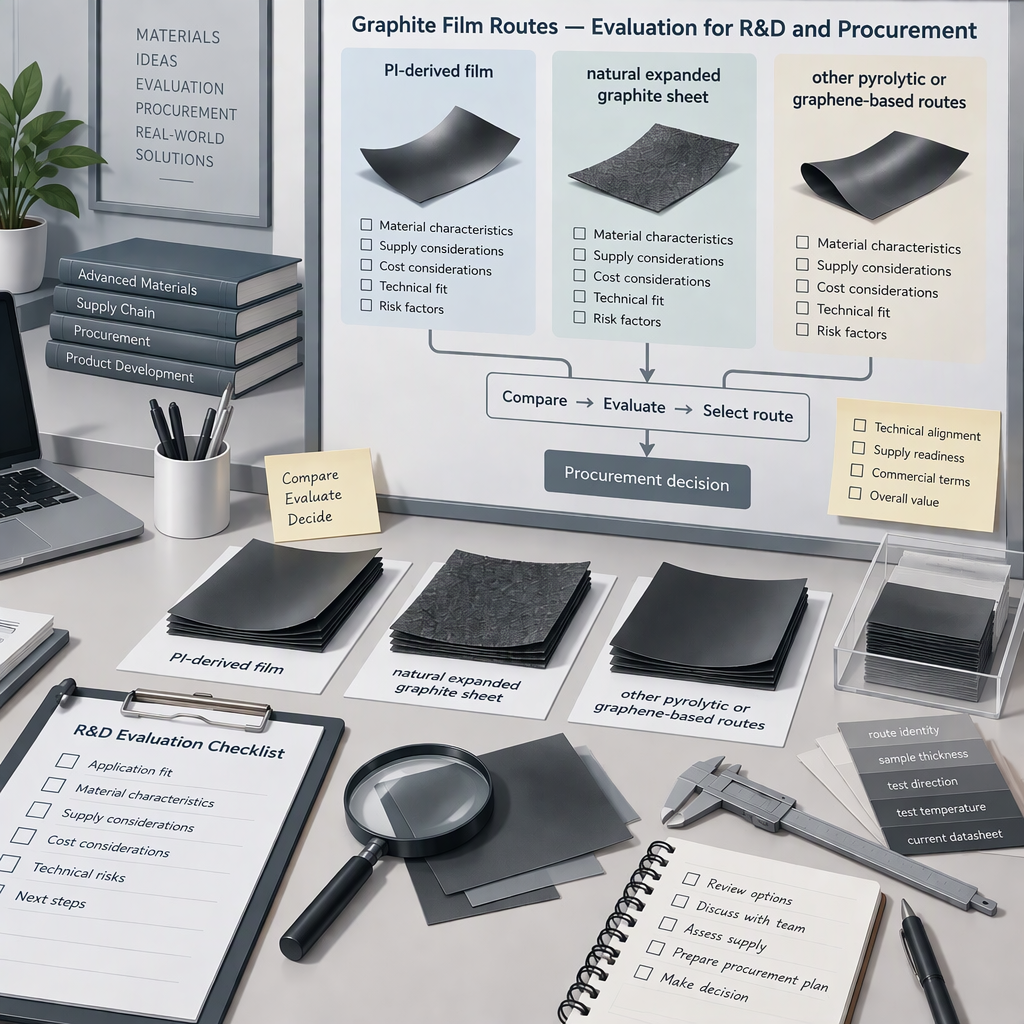
For a buyer, the PI-derived route identifies a synthetic graphite film made from a polyimide precursor through carbonization and graphitization, rather than a sheet made by expanding and compressing natural graphite.
Academic manufacturing literature describes polyimide-derived graphite films as films prepared from polyimide by carbonization and graphitization. That route also makes the precursor chemistry, molecular orientation, heat-treatment temperature and molding pressure relevant process variables for the final material.
This is useful for procurement because the route narrows the material family. If a supplier says “polyimide derived synthetic graphite film,” the buyer should expect the discussion to start with PI precursor selection, thermal conversion and graphitic orientation, not with natural graphite flakes or compressed exfoliated graphite sheet.
The route is a classification clue, not a datasheet; buyers still need measured properties, sample form, test conditions and application-specific acceptance criteria.
The same PI-derived route can be influenced by precursor nature, molecular orientation, heat-treatment temperature and molding pressure, so two films with similar route language may still differ in final properties.
Published PGS transport work may also be narrower than a sourcing decision: one arXiv record reports measurements on uncompressed pyrolytic graphite sheet with 10–100 μm thicknesses at 2–300 K, a scope that should not be read as a room-temperature product specification for every PI-derived film.
Even the title and framing of a research record can change by version; the earlier arXiv v1 record framed the material as an adsorption substrate for superfluid thin films while describing a broad measurement set on uncompressed PGS.
Buyers can reduce misclassification risk by separating the route label, starting material, sheet formation method and proof needed before comparing quotations.
Route label buyers may see | What it usually signals | Main sourcing risk | What to request next |
|---|---|---|---|
PI-derived synthetic graphite film | A film prepared from polyimide through carbonization and graphitization. | Assuming the route alone proves thermal performance or application fit. | Ask for the film datasheet, sample thickness, test method, test direction and application validation data. |
Natural expanded graphite sheet, graphite foil or flexible graphite | A material made from natural graphite flakes by intercalation, rapid heating to exfoliated particles and compression. | Treating graphite foil terminology as interchangeable with PI-derived film terminology. | Ask whether the sheet is compressed exfoliated natural graphite, its density, compression state and anisotropic property data. |
Oriented pyrolytic, flexible graphite or graphene-based graphite film | A different graphite-film category rather than proof of the PI precursor route. | Comparing unlike route families as if they were one material grade. | Ask the supplier to state precursor, route, sheet form, thickness range and the intended heat-spreading application. |
Use published uPGS data to understand testing scope and physical questions, not as a substitute for supplier-specific data or current commercial availability.
The current arXiv record for “Low temperature transport properties of pyrolytic graphite sheet” reports thermal and electrical transport measurements on uncompressed pyrolytic graphite sheet with 10–100 μm thicknesses at 2–300 K.
That record also compares uPGS with exfoliated graphite sheets such as Grafoil within a low-temperature transport context. The comparison is useful for understanding how researchers separate sheet families, but it should stay inside that test context when procurement evaluates a real application.
The earlier v1 record carried a different title and described morphology, crystalline structure, impurities, defects, gas adsorption and electrical and thermal transport characteristics for 10–100 μm uncompressed sheets.
For application selection, match any cited research to the buyer’s actual temperature range, compression state, thickness, surface contact condition and required direction of heat flow before using it in a material approval file.
Treat Kaneka’s “Intellectual Property Report 2013” as historical competitor context for process and phone-application questions only, not as proof of current supply, current performance or any other supplier’s capability.
If a sourcing file cites that 2013 report while comparing polyimide-derived synthetic graphite film for a phone or other electronics application, use it to frame questions, not to approve a material. Ask the supplier under review for current grade-specific documents, current application limits and current test data for the exact film being quoted.
Do not transfer competitor history to DASEN, and do not treat a historical process reference as evidence of present commercial availability, present product performance, certification status, delivery capability or customer results. The safer procurement rule is to keep process context separate from supplier qualification.
The route still matters because it tells procurement which questions to ask first and which materials should not be compared as direct substitutes.
Start with the precursor and route: for PI-derived film, ask how the polyimide precursor, orientation and heat-treatment route are controlled.
Confirm whether any “graphite sheet” offer is instead based on natural graphite flakes that are intercalated, exfoliated and compressed.
Separate identification from approval: use the route to shortlist candidate material families, then use measured data to approve the application.
Compare samples under the same conditions: thickness, density or compression state, heat-flow direction and test temperature should be aligned before quotations are judged.
Before approving a graphite film for an application, procurement should request route identity, sample form and test data rather than accepting a broad graphite label.
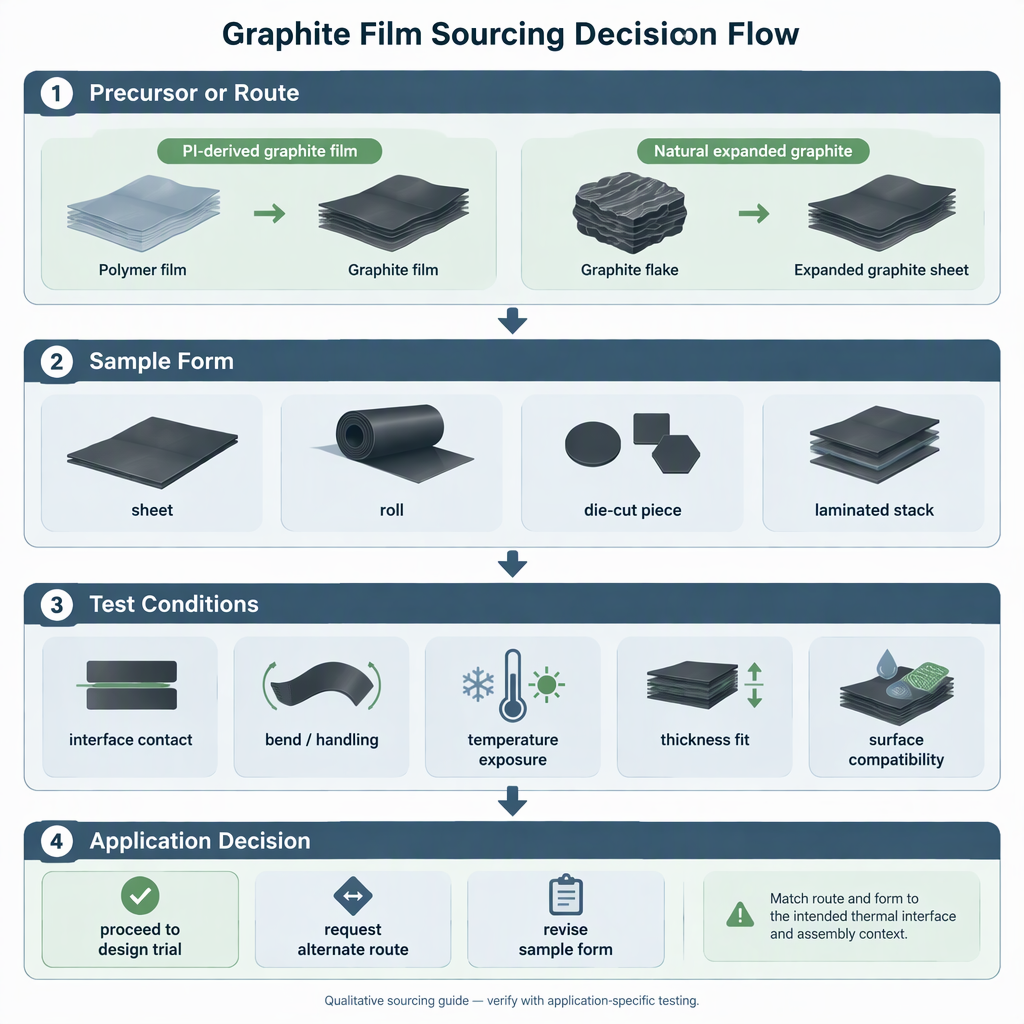
Procurement question | If the answer is clear | If the answer is unclear |
|---|---|---|
Is the film explicitly PI-derived? | Continue with PI precursor, carbonization and graphitization questions. | Do not compare it as PI-derived until the supplier states the precursor and route. |
Is it natural graphite sheet, graphite foil or flexible graphite? | Evaluate it as compressed exfoliated natural graphite, including density and anisotropy. | Ask whether natural graphite flakes, intercalation, exfoliation and compression are part of the route. |
Are research data being used to support the selection? | Check thickness, temperature range and compression state against the intended application. | Request application-specific test data before approving the material. |
Is the source a historical competitor process reference? | Use it only to form due-diligence questions about route, application context and current proof. | Do not approve the material until the current supplier provides its own current documentation. |
Request the exact route description, not only the phrase “graphite film.”
Request sample thickness and whether the sheet was tested compressed or uncompressed.
Request thermal data by direction, test temperature and method.
Request electrical, mechanical or handling data only where the application actually depends on them.
Request the supplier’s current datasheet for the exact grade under consideration.
Keep any Kaneka “Intellectual Property Report 2013” reference in the background as historical competitor context, and require current supplier-specific proof before selection.
Most sourcing mistakes start when buyers treat several graphite-sheet names as interchangeable before checking route and sample form.
Do not assume “graphite foil,” “flexible graphite” and “compressed exfoliated natural graphite” mean PI-derived film; the natural graphite sheet literature uses multiple names for natural graphite-based sheet materials.
Do not assume “high thermal conductivity graphite film” identifies one manufacturing route; PI-derived, natural graphite-derived, oriented pyrolytic, flexible graphite and graphene-based categories can be distinguished in the literature.
Do not turn low-temperature uPGS research results into a general commercial datasheet; the reported study scope includes uncompressed sheets, 10–100 μm thicknesses and 2–300 K measurements.
Do not use Kaneka’s “Intellectual Property Report 2013” as proof of current supply, current performance, phone heat-spreading results or another supplier’s capability; ask each supplier for current product-specific documents.
The practical rule is simple: use the route label to identify the material family, then use current test data to decide whether the material fits the application.
PI-derived synthetic graphite film points to a polyimide precursor followed by carbonization and graphitization.
Natural expanded graphite sheet belongs to a different route based on natural graphite flakes, exfoliation and compression.
Published uPGS studies can inform technical questions, but procurement should match their scope to the actual application before using them in selection.
Historical competitor process references can help buyers ask sharper questions, but they should not replace current supplier-specific proof.
These buyer questions help separate material identification from product approval.
No. PI-derived graphite film is described as being prepared from polyimide through carbonization and graphitization.
Natural graphite sheet is described as being made from natural graphite flakes through intercalation, rapid heating to exfoliated particles and compression.
No. The route points to the manufacturing family, while final properties are influenced by precursor nature, molecular orientation, heat-treatment temperature and molding pressure.
It can inform technical thinking only when its scope is respected: the cited arXiv record concerns uncompressed pyrolytic graphite sheet with 10–100 μm thicknesses measured at 2–300 K.
Ask each supplier for the exact route, precursor or starting material, sample thickness, compression state, test direction, test temperature and current grade-specific datasheet.
Use it only as historical competitor context for process and phone-application questions. Do not use it as proof of current supply, current performance, phone results, or capability of DASEN or any other supplier.
They matter because natural graphite sheet may appear under names such as compressed exfoliated natural graphite, graphite foil and flexible graphite, which can lead buyers to compare different material families as if they were identical.
No. The route should match the application requirement. A non-PI route may still be relevant for some designs, but it should not be evaluated as a PI-derived synthetic graphite film without route-specific and test-specific documentation.
Use them to frame questions about material family, sample form and test conditions, then request supplier-specific data for the exact material, thickness and application conditions under review.


