You are here: Home / News / Synthetic Graphite Rolls vs. Die-Cut Parts: Comparing Yield and Assembly Cost

Synthetic Graphite Rolls vs. Die-Cut Parts: Comparing Yield and Assembly Cost

Views: 0     Author: Site Editor     Publish Time: 2026-11-17      Origin: Site

facebook sharing button
twitter sharing button
line sharing button
wechat sharing button
linkedin sharing button
pinterest sharing button
whatsapp sharing button
sharethis sharing button

Choose synthetic graphite rolls when your team can control converting, nesting, scrap and line-side handling; choose die-cut parts when the delivered format reduces internal cutting, peeling, placement and inspection work. The right comparison is usable installed cost, not roll area price versus finished-part unit price.

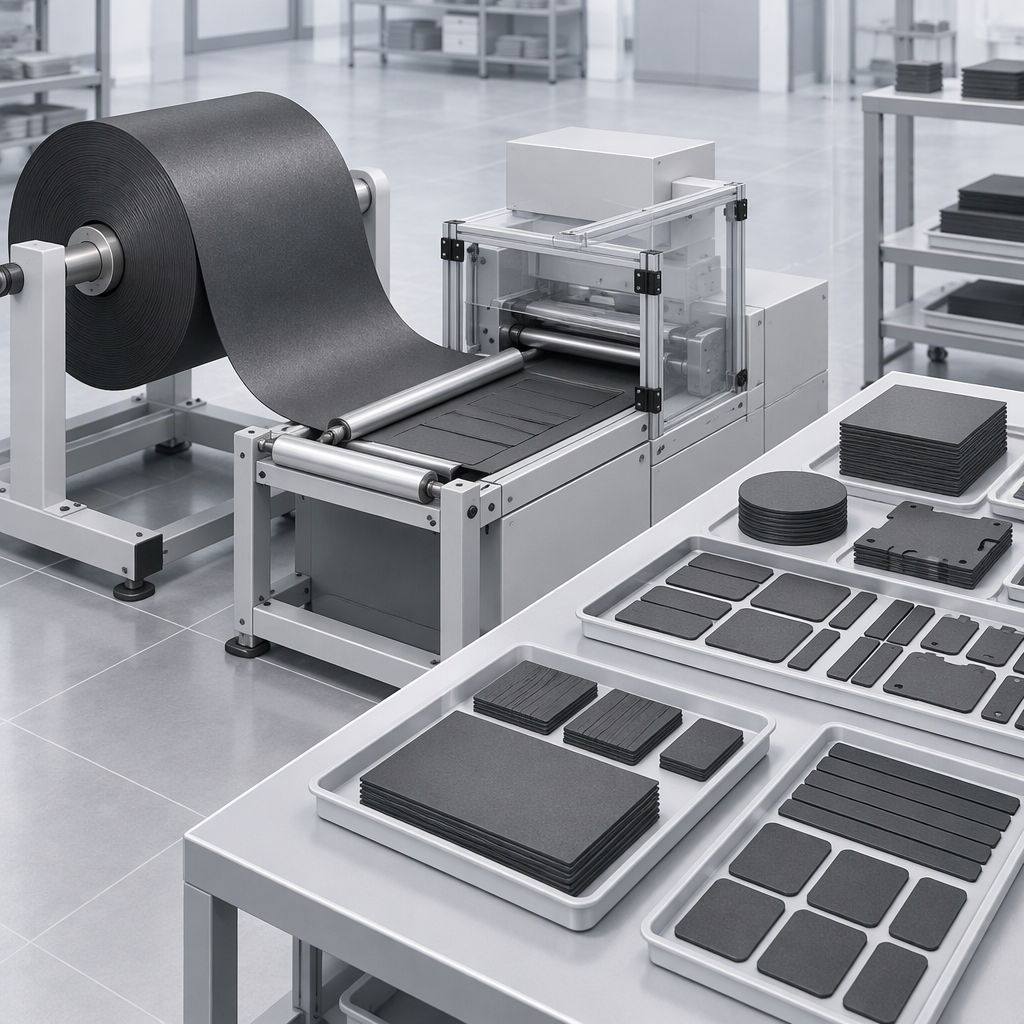
Generic comparison of graphite roll converting and organized die-cut graphite parts for assembly

Rolls vs. die-cut graphite parts: what is being compared?

Compare buying graphite sheet material for your own converting flow with buying parts already cut to the assembly shape.

Roll supply

Rolls give manufacturing teams more control over blank size, nesting direction, changeovers and whether scrap stays inside the buyer’s process. They can fit programs where shapes change, volumes are uncertain or the plant already owns compatible cutting and inspection steps.

Die-cut supply

Die-cut parts move more of the converting work upstream. They can fit programs where the assembly line needs repeatable pieces, predictable presentation and less manual handling at the point of installation.

Treat graphite thermal-management materials as sheet-type inputs for electronics thermal applications, including power modules, servers, base stations, inverters and converters.

Why square-meter price is the wrong comparison unit

A roll price per square meter and a die-cut part price describe different cost boundaries, so procurement should normalize both quotes to usable installed parts.

Cost item Roll quote Die-cut quote
Material area Quoted by area, then reduced by nesting loss, edge trim and process scrap. Embedded in the finished-part price.
Converting work Cutting, handling and inspection may sit inside the buyer’s factory or with a separate converter. Usually included before delivery, but drawing control and packaging still need review.
Assembly handling Line operators may need to separate, orient and place cut pieces from an internal process. Presentation format can reduce line-side preparation when it matches the assembly method.
Risk to compare Under-counting scrap and labor can make the roll option look cheaper than it installs. Ignoring packaging, liner, minimum order and revision-control needs can make parts look simpler than they are.

Ask both suppliers to quote the same installed output: drawing revision, finished dimensions, adhesive or non-adhesive construction if applicable, release format, packaging quantity, inspection basis and responsibility for scrap.

How to calculate yield with your own scrap data

Use your own drawing set and production route to calculate yield; do not assume a universal scrap advantage for either supply form.

  1. Start with the finished part drawing, including length, width, corner radii, holes, tabs, orientation marks and any keep-out zones.
  2. Build a nesting layout for the roll width or sheet width being quoted, including edge trim, web handling allowance and spacing needed for clean separation.
  3. Count good parts per usable area, then separate unavoidable layout waste from process scrap caused by setup, changeover, handling damage or inspection rejection.
  4. For die-cut parts, ask whether the quoted price includes the scrap matrix, tooling, release carrier, packaging format and inspection plan.
  5. Convert both options to cost per accepted part at the assembly point, then add internal labor, WIP handling and quality-control time.
Question If the answer is yes If the answer is no
Do part shapes change often? Rolls may preserve flexibility. Die-cut parts may reduce repeated internal setup.
Can the plant measure scrap by layout and changeover? Roll yield can be compared with confidence. Ask for a trial layout or quote die-cut parts to expose the hidden loss.
Is line-side placement the bottleneck? Part presentation and liner format may outweigh raw material price. Material utilization may carry more weight.

How liner structure changes assembly cost

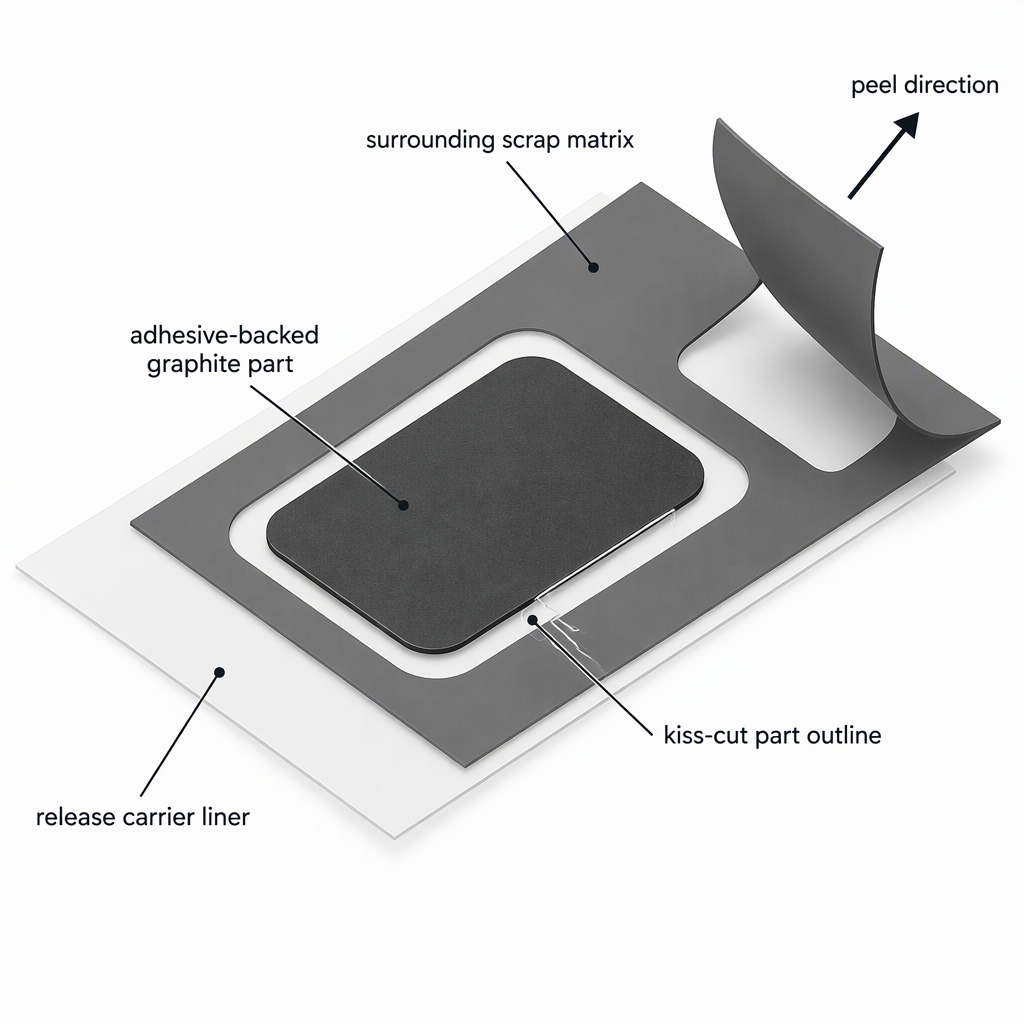
Release liners protect adhesive products until the user is ready for adhesion, and they may use paper or film substrates with silicone or non-silicone release coatings. A liner designed for kiss-cutting and similar converting can affect how finished parts are presented and removed.

Diagram of carrier liner, kiss-cut graphite part, scrap matrix and peel direction

In adhesive-backed constructions, the release liner is not just packaging; it is part of the handling system that controls when the adhesive surface is exposed.

Kiss-cutting uses a carrier-style approach in which the part can be cut while the liner helps keep the converted format organized for later removal.

Liner or carrier choice Assembly-cost effect to evaluate
Paper or film liner substrate Check stiffness, curl, operator grip and compatibility with your dispensing or manual placement method.
Silicone or non-silicone release coating Confirm release behavior and adhesive exposure requirements with the supplier for the specific construction.
Kiss-cut carrier format Evaluate whether parts can be peeled, picked and oriented faster than loose pieces or internally cut blanks.

When rolls fit best—and when die-cut parts fit best

Rolls usually fit flexible converting strategies; die-cut parts usually fit controlled assembly presentation and repeatable placement.

Rolls fit best when

  • Engineering revisions are still active.
  • Several part sizes can share one material format.
  • Your site or converter can document nesting, scrap and inspection results.
  • Internal capacity is available for cutting and handling.

Die-cut parts fit best when

  • Part geometry is stable.
  • The assembly cell benefits from parts presented in sequence or on a carrier.
  • Internal cutting adds WIP, handling risk or quality variation.
  • Procurement wants one finished-part quote tied to the drawing revision.
Production condition Likely sourcing direction Why it matters
Graphite sheet material used across several electronics applications Compare both forms by project, not by a universal rule. Application geometry and assembly method drive the usable-cost result.
Adhesive-backed part needs liner control Review die-cut presentation carefully. The liner can influence exposure timing and handling.
Kiss-cut presentation is requested Ask whether the carrier format matches the assembly method. The converting format can change peeling and placement work.

Decision table for sourcing synthetic graphite supply form

Use a decision table to turn the roll-versus-die-cut discussion into comparable quote requirements.

Decision factor Rolls favor Die-cut parts favor
Yield visibility Your team can create and validate the nesting plan. The supplier can quote accepted finished parts to the drawing.
Labor location Internal converting labor is available and controlled. Assembly labor is constrained and should focus on placement.
Revision frequency Geometry may change before the program stabilizes. Geometry is stable enough for tooling, carrier and packaging decisions.
Adhesive release requirement Buyer must manage liner removal after internal converting. Supplier can present parts on a specified release structure.
Kiss-cut requirement Buyer or converter must control the kiss-cut process. Finished carrier format can be specified in the part quote.

RFQ checklist: what to ask before comparing quotes

A useful RFQ makes roll and die-cut quotes answer the same manufacturing question: what does one accepted installed part cost?

  • Provide the drawing revision, finished dimensions, tolerance needs and inspection characteristics.
  • State whether the construction is adhesive-backed, non-adhesive or still undecided.
  • If adhesive is involved, ask for the release-liner substrate and release-coating approach to be identified.
  • If kiss-cut parts are requested, ask how the carrier, scrap matrix and peel direction will be presented.
  • For rolls, request usable roll width, recommended nesting constraints, edge trim assumptions and scrap ownership.
  • For die-cut parts, request packaging quantity, orientation, labeling, tooling assumptions and revision-control process.
  • Ask each supplier to separate one-time tooling or setup charges from recurring part or material prices.
  • Require sample-review criteria before moving from quote comparison to production approval.

Selection risks to check before choosing a form

The biggest risk is choosing the lower-looking quote while leaving scrap, liner handling, internal labor or drawing-control work outside the comparison.

  • Do not compare area price with part price unless both have been converted to accepted installed output.
  • Do not assume a universal yield percentage; calculate it from your actual part geometry and roll or sheet format.
  • Before reusing assumptions from another electronics application, review the project’s own geometry, handling method and assembly route.
  • For adhesive-backed parts, do not treat the release liner as a minor packaging detail; it controls when the adhesive surface is available for bonding.
  • For kiss-cut formats, check how the carrier supports removal, orientation and handling before assuming assembly labor will fall.

How to use competitor specifications in an RFQ

Use competitor specifications as checklist prompts only, not as confirmation that another supplier can provide the same construction, performance, compliance status or commercial conditions.

A competitor sheet can help procurement remember which fields to ask about: thickness, drawing revision, adhesive construction, liner type, carrier format, packaging and inspection basis. It should not be copied into a supplier comparison as if it described a different manufacturer’s product. Ask each bidding supplier to provide its own current documents for the exact part, roll format or die-cut construction being quoted.

Conclusion

The best choice is the supply form that gives the lowest controlled cost per accepted installed part, with yield, converting, liner and assembly work all inside the calculation.

For early engineering changes, rolls may protect flexibility. For stable assemblies, die-cut parts may reduce internal converting and line-side handling. Ask suppliers to quote the same drawing, release structure and packaging assumptions so the comparison reflects the real manufacturing route.

  • Normalize quotes to accepted installed parts.
  • Calculate yield from your own layout, not a generic percentage.
  • Review liner and carrier format whenever adhesive-backed parts are involved.
  • Use competitor documents only to improve your question list.

FAQs about synthetic graphite rolls vs. die-cut parts

These questions help procurement and manufacturing engineers finish the roll-versus-die-cut comparison before requesting final quotes.

Is a roll always cheaper than a die-cut part?

No. A roll can look cheaper by area, but the final comparison should include usable yield, internal cutting, handling, inspection and assembly time.

Can die-cut parts guarantee better yield?

No universal yield advantage should be assumed. Die-cut parts can make yield more visible in the quote, but the result depends on geometry, nesting, tooling and supplier process control.

What is the most important number for procurement?

Use cost per accepted installed part. That number lets procurement include material, scrap, conversion, presentation, labor and quality-control work in one comparison.

When does liner selection matter most?

Liner selection matters most when the graphite construction is adhesive-backed, because the liner protects the adhesive surface until the user is ready for adhesion.

Why ask about kiss-cut format?

A kiss-cut carrier can affect how parts stay organized, peel from the liner and reach the assembly point, so it should be specified when presentation matters.

Should a buyer use a competitor specification in an RFQ?

Use it only to build a list of questions. Each supplier should confirm its own material construction, dimensions, release format, inspection basis and commercial conditions.

What should engineering provide before quotes are compared?

Engineering should provide the current drawing, revision status, target assembly method, adhesive or liner needs, inspection criteria and expected packaging or orientation needs.

GET IN TOUCH

  No.888, Guangming Road, High-tech Zone, Xinyu, Jiangxi, China
  +86-512-6638 9461
  +86-138 6217 7522

PRODUCT LINKS

QUICK LINKS

Copyright © 2023 Jiangxi Dasen Technology Co., Ltd.