
Views: 0 Author: Site Editor Publish Time: 2026-10-08 Origin: Site


Synthetic or natural—which graphite sheet fits your project? There is no single winner. Your choice depends on what you need: cost versus performance, purity versus availability.
Think about cooling a high-end gaming laptop versus an industrial LED array. Each needs different solutions. Thermal conductivity, purity, cost, and environmental impact all play a part in the choice.
The graphite sheet market is expected to grow by 6.5% each year from 2026 to 2033.
This growth comes from rising demand in electronics and energy fields. You need steady heat control for your designs. A synthetic Graphite Sheet gives you consistent, engineered quality. Natural graphite offers raw performance for less money. This guide gives you clear, data-based comparisons to help you pick the right one.
Natural graphite is cheaper and spreads heat well.
Synthetic graphite is very pure and its quality is always the same.
The choice you make depends on what matters most: saving money or getting better performance.
Natural graphite works well for low-cost projects that only need average heat.
Synthetic graphite works well for high-tech devices that need steady cooling.
Graphite sheets move heat sideways, not through their thickness.
Synthetic graphite costs more because producing it requires a large amount of energy.
Choose natural for LED lights and home appliances; choose synthetic for smartphones and medical equipment.
Graphite sheets are thin, bendable layers of carbon atoms set in hexagon patterns. Think of them as flat, light panels that pull heat away from sensitive parts. Companies make these sheets in two main types: natural graphite, dug from the ground, and synthetic graphite, made in factories. Both types work as a heat dissipation material that you put between a hot source and a cool area.
These sheets are part of a larger group called thermal interface materials. You use them to fill small gaps between a hot chip and a metal heatsink. Without this filler, air pockets trap heat and slow cooling. Graphite sheets work well for this job because they stay stable over both hot and cold temperatures. They also resist chemical damage, so they last a long time in electronics, car systems, and medical devices.
Thermal conductivity tells how fast a material moves heat. High numbers mean heat moves quickly, keeping parts cool. When a material lacks enough conductivity, problems grow fast. Temperature causes over 55% of electronic device failures. Poor heat transfer leads to thermal cycling fatigue, which creates cracks and broken solder joints. You might see slower performance, sudden shutdowns, or shorter battery life in your devices.
Overheating also brings safety risks. Lithium-ion batteries can go into thermal runaway when they get too hot. This state causes fast, out-of-control temperature rises that can cause fires or release toxic gas. High temperatures wear down batteries faster and shorten device life. For these reasons, engineers make thermal management a top priority in every design. They pick materials with proven conductivity to protect both performance and safety.
Graphite sheets have a special property called anisotropy. Heat moves differently based on direction. In- conductivity measures heat flow across the sheet's surface. Through- conductivity measures heat flow through its thickness. For thermal conductive graphite, the difference is huge.
Property | Value |
|---|---|
In- thermal conductivity | 600–1900 W/m·K |
Through- thermal conductivity | 3–20 W/m·K |
Anisotropic ratio (in- : through-) | ~500:1 |
This ratio means heat spreads fast across the sheet's surface but resists moving through its thickness. You can use this property on purpose. Lay the sheet flat against a hot part, and heat spreads sideways toward cooler edges. This action maximizes dissipation over a large area. The through- resistance stops heat from escaping upward, which helps protect nearby sensitive parts.
The anisotropic nature also gives graphite sheets their high temperature resistance. They keep their shape even after many heating and cooling cycles. This durability makes them great for demanding jobs where steady performance is key. Understanding anisotropy helps you put the sheet in the right position for best heat spreading in your design.
Natural graphite comes from rocks deep inside the Earth that changed under heat and pressure. Miners get this mineral in two main ways. Open-pit mining works for deposits close to the surface. Underground mining reaches deeper graphite veins that sit far below ground.
The extraction process follows several clear steps:
Mining: Workers take graphite ore from open pits or underground tunnels.
Crushing and grinding: Machines break the ore into fine pieces, making it easier to separate.
Concentration and beneficiation: Froth flotation pulls graphite away from impurities like quartz and mica. Gravity and magnetic separation also help remove unwanted materials.
Purification and refining: Chemical treatments with acids, high-temperature heating, or electrochemical methods remove remaining impurities.
Purity varies a lot based on where the graphite comes from. A peer-reviewed study on Sri Lankan vein graphite reports that material mined from the middle of the vein exceeds 99% carbon purity. Further processing can push this level to 99.99%. The same study details a sustainable acid-extraction method using concentrated sulfuric and nitric acids in an 8:1 ratio. This technique recovers graphite attached to waste rock pieces. Heat treatment at 600°C for 15 minutes increases carbon content by 8.05% while reducing oxygen content by 6.07%. These purification steps prove essential for producing high-purity natural graphite for batteries and electronics.
Natural graphite sheet has unique physical traits that make it useful for thermal management. The material's layered crystal structure gives it remarkable flexibility. You can bend a natural graphite sheet without breaking it, thanks to these sliding layers.
Mechanical properties show a wide range depending on manufacturing methods:
Tensile strength: 8 – 30 MPa
Flexural strength: 6.9 – 100 MPa
Graphite is brittle and breaks suddenly without much plastic deformation
Natural graphite sheets can bend without breaking due to their layered structure, giving them strength and flexibility.
The material also shows high thermal conductivity along its surface . Heat spreads quickly across the sheet's length and width. This property makes natural graphite an effective thermal conductive graphite for moving heat away from hot spots. The anisotropic nature means heat moves much slower through the sheet's thickness, which helps guide heat flow in specific directions.
Natural graphite also shows exceptional lubricity, meaning it lowers friction between surfaces. This quality proves useful in applications where parts slide against each other. The mix of flexibility, strength, and heat-spreading ability makes natural graphite sheet a flexible choice for many designs.
Natural graphite offers several clear benefits for thermal management applications. The material costs less than synthetic options because mining uses less energy than manufacturing. Natural graphite sheet provides excellent heat dissipation across large surface areas, making it ideal for spreading heat from concentrated sources.
The supply chain for natural graphite stays stable and well-established. Major deposits exist in China, Brazil, and Canada, ensuring steady availability. For bulk applications where cost matters most, natural graphite often gives the best value.
However, natural graphite has notable limits. Purity varies between batches because geological conditions differ across mining sites. This inconsistency creates challenges for applications needing precise, repeatable performance. The material also contains natural impurities that can affect electrical insulation properties.
Natural graphite sheet works best in applications where cost efficiency and high thermal conductivity matter more than absolute purity. You might choose it for LED lighting systems, household appliances, or automotive components. These applications benefit from the material's natural heat-spreading abilities without demanding laboratory-grade consistency.
Synthetic graphite starts as petroleum coke, a byproduct of oil refining. Manufacturers crush and screen this coke, then mix it with coal tar pitch to form a dense carbon mass. You can shape this mixture through several techniques, including extrusion, isostatic pressing, or die molding. Each method produces a different final structure.
The manufacturing process follows four main stages:
Mixing and Molding: Petroleum coke combines with coal tar pitch to create a dense carbon mass. Shaping techniques include extrusion, isostatic pressing, vibration molding, or die molding.
Carbonization: The shaped material heats to approximately 1000°C in oxygen-free furnaces. This step removes volatile substances and creates strong carbon bonds.
Graphitization: The carbonized material heats to nearly 3000°C. Carbon atoms rearrange into highly ordered graphite crystal structures during this phase.
Shaping and Machining: CNC machining cuts the graphitized material into final products, including sheets for electronics.
The graphitization step demands precise control. Temperatures reach 2800–3000°C in an Acheson-type furnace process. The total production cycle, including heating, holding, and cooling, spans 15–22 days. Some manufacturers use polyimide film as a starting material, which graphitizes at 2800–3200°C under an inert atmosphere.
Modern facilities like DASEN demonstrate advanced production technology in this field. DASEN operates a workshop spanning over 10,000 square meters with an annual production capacity of 6 million square meters. The company holds more than 10 invention patents and follows ISO9001 international quality management standards. This scale of operation ensures consistent output for demanding applications.
A synthetic graphite sheet offers properties that manufacturers can tune during production. You can adjust the raw materials, processing temperatures, and forming methods to achieve specific performance targets. This customizability sets synthetic options apart from natural materials.
Property | Range |
|---|---|
In- thermal conductivity | 1350 – 1600 W/m·K |
Through- thermal conductivity | 3.4 W/m·K |
Thickness | 0.017 – 0.050 mm |
The in- thermal conductivity of a synthetic graphite sheet reaches 1350–1600 W/m·K. This high value means heat spreads rapidly across the surface. Through- conductivity stays low at 3.4 W/m·K, which directs heat flow horizontally rather than vertically. You can select sheet thickness from 0.017 to 0.050 mm based on your space constraints and heat load.
Synthetic graphite also delivers high strength relative to its thin profile. The engineered structure resists cracking during installation and thermal cycling. You can bend these sheets around corners without losing performance, making them suitable for tight electronic enclosures.
The main advantage of synthetic graphite lies in its consistency. Every batch performs the same way because manufacturers control the entire process. This reliability matters when you design products that must meet strict performance specifications.
Synthetic powders promise higher purity and stable quality, whereas natural powders vary based on source and are generally more affordable.
Purity levels confirm this difference. Synthetic graphite exceeds 99.9% carbon purity. Natural types vary widely: amorphous graphite ranges from 70–85%, flake graphite from 90–95%, and vein graphite exceeds 98%. For applications requiring precise electrical insulation or consistent thermal performance, this purity gap proves critical.
The engineered nature of synthetic graphite also allows customization for specific heat dissipation needs. You can request modifications to density, porosity, or surface treatment during production. This flexibility helps you optimize the material for your exact application.
The main limitation is cost. The energy-intensive manufacturing process, with its 15–22 day cycles and extreme temperatures, drives prices higher than natural alternatives. You also face longer lead times because production runs take weeks rather than days.
Synthetic graphite suits applications where performance consistency matters more than upfront cost. You might choose it for smartphones, electric vehicle battery cooling systems, or medical devices where failure is not an option. The predictable quality justifies the premium price when your design demands reliable thermal conductive graphite performance.
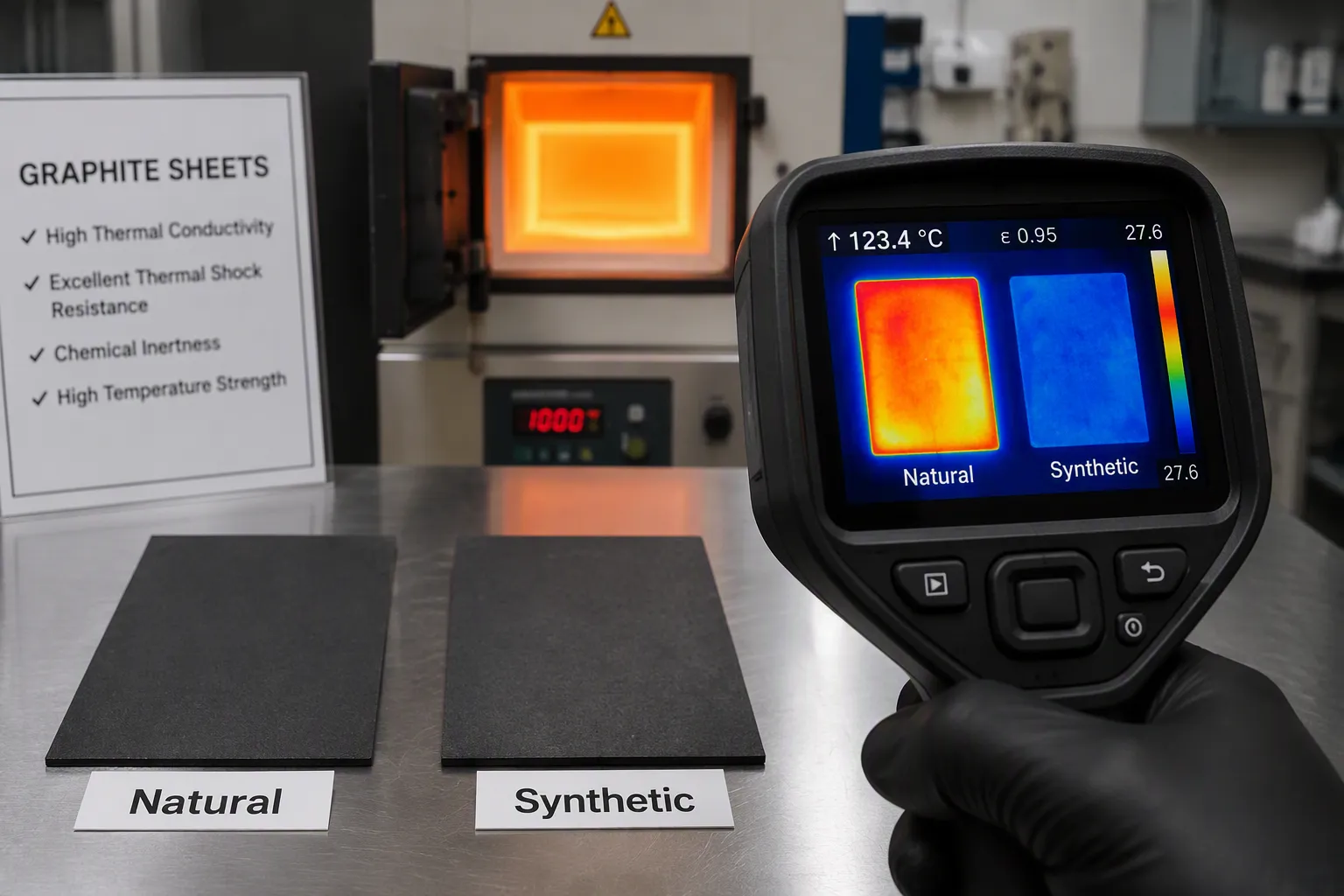
Thermal conductivity is the most important thing to check when you look at graphite sheets. The numbers show how each material works. Natural graphite sheets can move heat at up to 600 W/m·K across the surface. Synthetic graphite sheets usually do 100–350 W/m·K, but advanced methods can make them higher. These numbers are for in- direction, where heat spreads across the sheet's flat side.
How they make synthetic graphite changes its final ability to move heat. Different starting materials and steps give different results.
Manufacturing Method / Precursor | Reported In-Plane Thermal Conductivity (W/m·K) | Key Conditions / Notes |
|---|---|---|
Expanded graphite route (from natural flakes) | 300 – 1800 | Densities 0.04–1.9 g/cm³; heating to 2800–3000°C pushes it to 1500–1800 |
Polyimide-derived sheets | 500 – 1000 | Needs carbonization and graphitization of polyimide films; thickness ≥40 μm |
Fiber-based sheets | Ratio ≥300 (horizontal:vertical) | Low cost; uses cellulose paper or carbon fiber mats |
Heating at 2800–3000°C makes bigger crystals and lowers phonon scattering. This process can boost in- conductivity to 1500–1800 W/m·K. Rolling the sheet to densities above 1.5 g/cm³ lines up the graphite pieces and lowers resistance between them, which raises conductivity by 30–50%. Keeping ash content below 1 wt% also reduces phonon scattering.
For polyimide starting materials, better shape stability lets makers produce thick sheets with high conductivity and few defects. The expanded graphite route makes binderless sheets where lower densities work for gaskets and higher densities make heat move best across the surface.
These big differences in making the sheet affect your design choices. When you need the most heat spreading over a large area, natural graphite's raw conductivity often wins. When you need steady, predictable performance in a small device, synthetic options may work better even if their top numbers are lower.
Purity is the biggest difference between these two materials. Natural graphite has impurities from where it came out of the ground. Synthetic graphite is over 99.9% carbon because makers control every step. This purity gap creates real effects for your uses.
You can see the difference by looking. Natural graphite sheets look darker. Synthetic graphite sheets show a light gray color. This quick check helps you tell which material you have, but lab tests give exact numbers.
The steady quality of synthetic graphite matters for high-precision applications. DASEN's synthetic graphite sheets meet strict ISO9001 standards. This certification means every batch works the same, which is important when you make thousands of identical devices. Natural graphite changes between batches because mining conditions differ across places and even within the same mine.
For thermal interface materials, this steady quality gives you reliable performance. You can predict exactly how much heat your sheet will move under certain conditions. Natural graphite's changes mean you must design with bigger safety margins, which could add cost to your whole system.
Price differences between these materials come from how they are made. Synthetic graphite sheet prices range from $14 to $37 per square meter in some markets, while other sources say $2.00 to $6.00 per square meter. Natural graphite usually costs less because mining does not need the huge energy of making synthetic. But pricing changes by region, quality, and market conditions.
Supply chain problems affect both materials differently.
Aspect | Natural Graphite | Synthetic Graphite |
|---|---|---|
Key processing challenges | Needs 3 steps to reach battery-grade: purify to ≥99.95% purity, spheronisation, carbon coating | Needs graphitization above 2,500°C using electric furnaces; uses a lot of energy |
Feedstock risks | Geographic concentration: China has about 90% of world anode material market | Depends on petroleum coke prices tied to crude oil |
Scalability concerns | China's export permit rules add uncertainty | New anode materials need long qualification testing |
Natural graphite processing needs many purification steps to reach high purity. Spherical graphite costs 3–4 times more than flake concentrate. Synthetic graphite needs graphitization furnaces above 2,500°C, which uses huge amounts of electricity.
Geopolitical factors also affect supply. China has about 98% of global graphitization capacity. Export controls on high-purity graphite materials create uncertainty for buyers around the world. For synthetic graphite, petroleum coke prices change with crude oil markets, which affects production costs.
When you look at thermal conductive graphite for your project, think about the whole picture. Natural graphite gives good conductivity at lower cost but brings consistency risks. Synthetic graphite gives steady quality with higher upfront cost. Your choice depends on which factor—cost or consistency—matters more for your specific heat problem.
Sustainability matters more now than ever. You need to think about the environmental cost of your heat control choices. Natural and synthetic graphite sheets have different environmental footprints. Knowing these differences helps you make responsible decisions for your products.
The carbon footprint gap between these materials is large. Mining and processing natural graphite gives off 2 to 6 kilograms of CO₂ per kilogram of graphite. Making synthetic graphite gives off 20 to 40 kilograms of CO₂ per kilogram. The exact number for synthetic depends on the energy source used during graphitisation.
This table shows the direct comparison:
Material | CO₂ emissions (kg CO₂/kg) |
|---|---|
Natural graphite | 2 – 6 |
Synthetic graphite | 20 – 40 |
The graphitisation step uses a huge amount of electricity. Temperatures reach nearly 3000°C and the cycle lasts 15 to 22 days. This high energy use causes the bigger carbon footprint for synthetic options. Natural graphite avoids this intense heating because nature already formed the crystals under pressure.
But the picture changes when you look at the whole product life. Some modern synthetic graphite makers use renewable energy to lower their emissions. Your choice between these two materials depends on how you weigh raw emissions against other sustainability factors.
Lifecycle analysis gives deeper information beyond just production emissions. One study found that natural graphite anodes are about 55% less carbon intensive than the average synthetic graphite anode made in China. This finding comes from Benchmark’s Life Cycle Assessments.
Natural graphite anodes are about 55% less carbon intensive than the average synthetic graphite anode made in China, based on Benchmark's Life Cycle Assessments.
For extraction alone, natural graphite shows a range. A baseline scenario using diesel trucks and natural gas power gives off 2.2 kg CO₂ per kg of graphite concentrate. An optimized scenario using natural gas trucks and hydroelectric power cuts this to 1.0 kg CO₂.
Making synthetic graphite can also improve. One maker, Vianode, says that one kilogram of synthetic graphite anode has a climate impact of 1.9 kg CO₂ equivalents. That is a 90% drop from usual methods. The company aims to cut emissions to 1.0 kg CO₂ per kilogram by 2030.
End-of-life also matters. Graphite sheets are carbon materials that do not break down easily. Both natural and synthetic graphite can be recycled or reused. How well you can recycle them depends on how cleanly you separate the sheets from other parts. Designing for easy disassembly helps improve your product's overall sustainability.
DASEN shows a strong commitment to sustainable manufacturing. The company runs a 10,000 square meter workshop and can make 6 million square meters each year. DASEN has more than 10 invention patents and follows ISO9001 international quality management standards.
Picking a partner with sustainable practices helps you lower your own environmental impact. DASEN’s advanced production technology gives steady quality while cutting waste. The company's size lets it use resources efficiently during manufacturing.
When you check sustainability, look at the whole picture. Think about carbon footprint, life cycle emissions, and end-of-life choices. Your choice between synthetic and natural graphite should match your environmental goals. DASEN offers solutions that balance performance with responsibility.
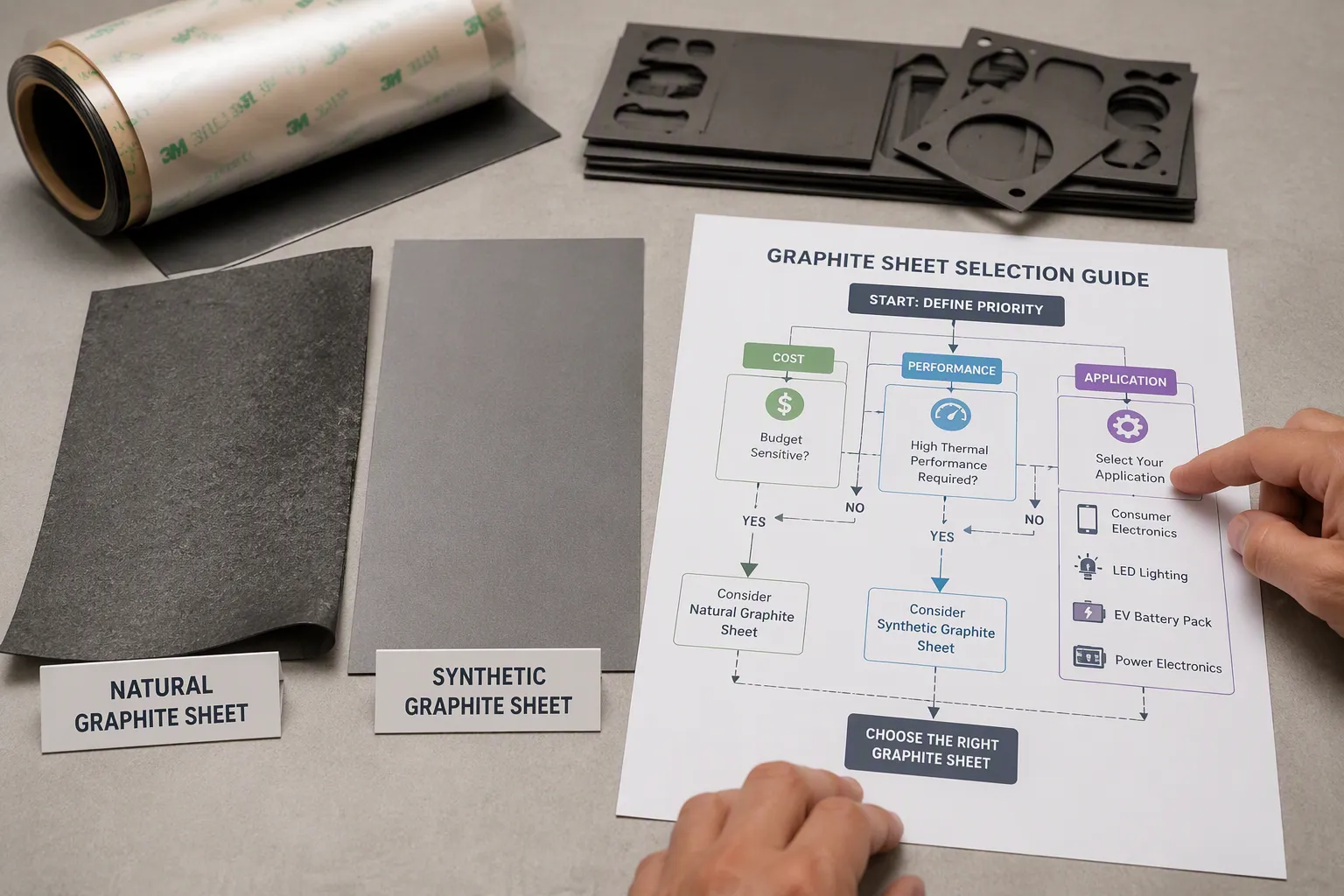
You now know the main differences between these two materials. The next step is matching those differences to your project. This framework guides you through the decision process step by step.
Natural graphite sheet works best when cost is the main factor. It costs less than synthetic options because mining avoids the energy-heavy graphitization process. You also save on tooling. Graphite sheets only need die-cutting, with tooling costs from $1,000 to $10,000. Copper heat sinks, in contrast, need machining or stamping with tooling from $5,000 to $50,000.
Assembly labor adds another benefit. Graphite sheets cut installation time by 40–60% because they have adhesive backing and are lightweight. You skip the mechanical fastening that copper needs. For heat loads below 30W, natural graphite performs well at a lower total system cost.
Natural graphite stays the top pick when cost matters most and performance needs are less strict.
The table below shows typical uses where natural graphite makes sense:
Application Area | Why Natural Graphite Fits |
|---|---|
Consumer electronics | Cost-sensitive mass-market devices where moderate heat spreading works |
LED lighting modules | Moderate heat loads where price matters most |
Power electronics | Cost-driven designs with less extreme heat density |
EV battery packs | Cell-to-cell management where cost per unit is critical |
Telecommunications equipment | Base stations needing reliable but not ultra-high conductivity |
Industrial computing | Budget-limited thermal solutions |
Natural graphite also processes easily. You can cut and shape it into flexible sheets that fit uneven surfaces, improving heat contact in real-world setups. The material's in- thermal conductivity reaches 140–500 W/(m·K), which handles moderate heat generation without problems.
One warning applies. Natural graphite may lose 5–15% performance over time due to adhesive aging. For many bulk uses, the upfront cost savings outweigh these long-term factors. You must decide whether your product's lifespan justifies the trade-off.
Synthetic graphite becomes necessary when purity and consistency are non-negotiable. The manufacturing process heats carbon materials to 2,500–3,000°C, allowing purity control by design. You consistently get 99.9% or higher purity. Natural graphite cannot match this near-perfect carbon content.
High-purity synthetic graphite suits applications needing extreme precision and reliability. Semiconductors demand predictable performance where even small purity differences affect conductivity and static dissipation. PCB ESD trays show this need clearly. Electronic electrodes require high-purity synthetic HOPG for stable, predictable resistivity.
The table below shows purity needs across application areas:
Application Domain | Required Purity / Ash Content | Rationale |
|---|---|---|
Nuclear & Semiconductor | Purity exceeding 99.995% (ash < 0.005%) | Trace impurities disrupt nuclear reactions or contaminate crystal growth |
High-tech Electronics & EDM | 99.9%+ purity, fine-grain | Uniform thermal expansion is non-negotiable |
Standard Industrial Grades | ~0.1% ash content | Lower purity acceptable where extreme precision is not critical |
Consumer electronics represent the largest use for graphite sheets. You use them as thermal interface materials to manage heat from high-performance processors and batteries. The push toward thinner, more powerful devices increases the need for efficient thermal solutions. Synthetic graphite becomes a critical, reliability-boosting part in device design.
DASEN's synthetic graphite sheets meet strict ISO9001 standards. This certification ensures every batch performs the same. When you make thousands of identical devices, this consistency prevents costly quality variations.
Start your evaluation by listing your main limits. Ask yourself three questions. First, what is your budget per unit? Second, what heat load must your design handle? Third, what purity level does your application need?
The table below summarizes key property considerations:
Property | Key Finding |
|---|---|
Thermal conductivity | Highly anisotropic and density-dependent |
Through- conductivity | Increases up to 116% when compression rises from 100 to 1080 kPa |
Electrical conductivity | Increases up to 263% under the same compression range |
Coefficient of thermal expansion | In- is low and negative; through- reaches 33 × 10⁻⁶ K⁻⊃1; |
Contact resistance | Negligible between stacked sheets at 100–1080 kPa |
Compare material options against your needs:
Material | Thermal Conductivity (W/mK) | Key Feature |
|---|---|---|
Aluminum (6061) | ~167 | Balanced cost & performance |
Copper (C110) | ~391 | Highest performance |
Graphite | 25–1500 | Directional heat transfer |
Graphite offers a wide thermal conductivity range, giving you design flexibility. Its directional heat transfer requires careful layout planning. You must account for the anisotropic nature when placing sheets.
For cost-driven bulk uses, natural graphite delivers value. For high-precision electronics needing consistent performance, synthetic graphite justifies its higher price. When you need a thermal conductive graphite that balances both factors, examine your volume economics carefully. Graphite sheet pricing stays stable even at high volumes. This stability makes graphite more economical for moderate-volume bulk uses than metals whose unit costs drop only above 100,000 units annually.
Your final choice aligns with your main limit. Identify whether budget, performance ceiling, or purity requirement matters most. Let that answer guide your selection.
The choice between these materials comes down to your project's needs, not absolute superiority. Natural graphite delivers higher raw thermal conductivity at lower cost for bulk applications. Synthetic graphite provides superior purity, consistency, and controlled performance for high-tech demands.
Identify your primary constraint first. Budget drives you toward natural graphite. Performance ceilings or purity requirements point you to synthetic graphite. Let that answer guide your selection.
DASEN offers tailored thermal management solutions backed by more than 10 patents and 6 million square meters of annual capacity. Consult their team to match the right graphite sheet to your specific application.
Natural graphite comes from mining. Synthetic graphite is made in factories. Natural costs less. Synthetic gives you higher purity and more consistent quality. Your choice depends on what your project needs most: cost, performance, or purity.
Natural graphite sheets can reach up to 600 W/m·K. Synthetic graphite sheets usually give 100 to 350 W/m·K. Advanced production methods can make synthetic higher. Natural graphite generally offers better raw thermal conductivity.
Synthetic graphite needs a process that uses a lot of energy. The graphitization step heats materials to nearly 3000°C for 15 to 22 days. This process uses huge amounts of electricity. These costs push the price higher.
Natural graphite works well for cost-sensitive uses like LED lighting and household appliances. For high-precision electronics, pick synthetic graphite. Its steady purity above 99.9% carbon makes it a better choice for reliability.
Natural graphite sheets look darker in color. Synthetic graphite sheets appear light gray. This quick visual check helps you identify which material you have without lab testing.
Anisotropy means heat moves differently based on direction. Graphite sheets spread heat fast across the surface. They resist heat flow through their thickness. You can use this property to guide heat where you want it.
Find your main limit first. If budget matters most, choose natural graphite. If purity and consistency are critical, choose synthetic graphite. DASEN offers both types to match your specific thermal management needs.
Yes, DASEN makes both synthetic and natural graphite sheets. The company runs a 10,000 square meter workshop with 6 million square meters annual capacity. DASEN holds more than 10 patents in thermal management solutions.