
Views: 0 Author: Site Editor Publish Time: 2026-08-20 Origin: Site


You often need to pick the best way to cool electronics. When you look at graphite sheet vs silicone pad, graphite sheets move heat much better. See the table below:
Material | Thermal Conductivity (W/m·K) |
|---|---|
Silicone Pads | 2 to 10 |
Graphite Sheets | > 1000 |
Graphite sheets move heat fast and fit device shapes. Silicone pads fill spaces and help things touch well. What you pick depends on your device, how you install it, and your budget. DASEN makes special cooling materials and has many choices for you.
Graphite sheets are very good at moving heat fast. They help keep high-performance devices cool. Silicone pads stop electricity from passing through. They also fill in spaces to protect important parts. Think about what your device needs to stay cool. Also, think about how you will put the material in. DASEN has many thermal management materials. You can find the best one for your electronics. Always look at the price and how well it works. Graphite sheets can cost more but cool better.
It is important to know the differences between graphite sheet and silicone pad. Each material works in its own way to cool electronics. Look at the table below to compare them:
Property | Thermal Graphite Sheet | Thermal Silicone Pad |
|---|---|---|
Composition | Made from polyimide film or graphite powder | Made with silica gel and metal oxides |
Thermal Conductivity | Very high, up to 1000 W/m·K | Moderate, between 2 and 10 W/m·K |
Thickness | Very thin, good for tight spaces | Thicker, fills bigger gaps |
Flexibility | Very flexible, fits device shapes | Some flexibility, covers uneven surfaces |
Electrical Insulation | No | Yes |
Additional Functions | Insulation and heat spreading | Shock absorption and sealing |
Cost | More expensive | Less expensive |
Application Range | Used in phones, tablets, LED lights | Used in many electronics and power devices |
Graphite sheets move heat much better than silicone pads. Silicone pads keep electricity from passing through and help protect devices. Both materials are important for keeping electronics cool.
DASEN is a trusted company for thermal management materials. You can get strong graphite sheets and good silicone pads from DASEN.
Graphite sheets are used in devices that need quick heat movement. These devices include laptops, small LED modules, and RF parts. The layers in graphite sheets help take heat away from hot spots.
Silicone pads are good for filling spaces and keeping devices safe. You find them in EV chargers, solar inverters, and telecom stations. Silicone pads cover uneven surfaces and protect from changes in the environment.
Flexible graphite pads fit uneven surfaces and handle lots of heat.
Silicone pads stop electricity and fill gaps but do not move heat as well.
You should think about what your electronics need before picking a material. DASEN has options for both, so you can get the best cooling for your devices.
Thermal conductivity is very important when picking cooling materials. It shows how well something moves heat away from hot spots. Good thermal conductivity keeps devices cool and helps them work better. Using the right thermal interface materials lowers the chance of overheating. This also makes your electronics perform better.
Graphite sheets are special because they move heat really fast. Their structure lets them spread heat quickly and easily. The strong bonds in one direction help heat move sideways faster than most other materials.
In synthetic graphite, heat moves sideways through strong bonds and electron flow. This happens because of covalent bonds in the horizontal direction. Heat moves up and down using weaker van der Waals forces. This makes the thermal conductivity different in each direction.
Graphite sheets are great at moving heat sideways. This helps take heat away from hot spots. DASEN’s graphite sheets can have thermal conductivity over 1,500 W/m·K. This is much higher than copper, which is about 400 W/m·K. Graphite sheets are also lighter and thinner. This helps when you need to save space in your device.
Silicone pads work in a different way than graphite sheets. They fill gaps between surfaces and help heat move from one part to another. Silicone pads are soft and can cover bumpy surfaces. This makes them useful in many devices.
Silicone pads mostly move heat up and down, not sideways.
Graphite sheets, especially slice graphene pads, spread heat sideways very well.
The carbon structure in graphite sheets lowers thermal resistance and helps heat move better than silicone pads.
Silicone pads have medium thermal conductivity, usually from 2 to 10 W/m·K. They are best when you need electrical insulation and shock absorption. You can use them where surfaces do not match up. DASEN has silicone pads that help with both heat transfer and protection.
When you think about cooling, you should look at how well each material handles heat. DASEN’s graphite sheets and silicone pads have been tested in labs.
High thermal conductivity films can show a temperature drop of almost 10 degrees compared to regular materials.
This big difference is important for customers.
Graphite sheets have thermal conductivity over 1,500 W/m·K, much better than copper’s 400 W/m·K.
They are lighter than copper and aluminum, so devices weigh less.
Their thin size means they fit in small spaces without making things bulky.
Graphite sheets are the best choice if you want to move heat fast and keep devices cool. Silicone pads are still good for filling gaps and giving insulation. Both materials help keep electronics safe and cool. Always think about what your device needs and how the parts fit together before you choose. DASEN has many thermal management materials, like thermally conductive foams, to help your devices stay safe and cool.
CPUs, GPUs, and power devices get very hot when they work. These parts need good cooling to keep working well. Graphite sheets move heat away much faster than silicone pads. This helps cool hot spots quickly. You can use graphite sheets in processors and graphics cards. They handle lots of heat and spread it out well.
Silicone pads are good for power devices that need insulation and gap filling. They protect sensitive parts and keep things steady. Look at the table below to see how materials compare:
Material | Advantages |
|---|---|
Aluminum | Light and cheap |
Moves heat well | |
Copper | Moves heat even better |
Good for high heat jobs |
Graphite sheets work better than aluminum and copper in many cases. They give better heat movement and work well in devices that need strong cooling.
You use electronics like phones and LED lights every day. These need good cooling to last longer. Graphite sheets are great because they move heat fast and have low resistance. They fit uneven surfaces and fill gaps between hot parts and coolers.
Silicone pads are soft and can be pressed. They fill gaps in bumpy surfaces. They work well in electronics where shock absorption and insulation are important. See the list below for their main advantages:
Graphite sheets:
Move heat very fast (up to 1500 W/m-K)
Low resistance to heat
Flexible and fit surfaces
Good for high-power devices
Silicone pads:
Soft and easy to press
Fill gaps in uneven surfaces
In industrial electronics, you need materials that can handle tough places. Graphite sheets resist chemicals, dirt, and oil. Silicone pads absorb shocks and stop vibrations. Compare their features in the table below:
Feature | Graphite Sheet | Silicone Thermal Pad |
|---|---|---|
Thermal Conductivity | 300 to 1500 W/mK | 1 to 15 W/mK |
Electrical Conductivity | Conductive | Insulating |
Application Compatibility | Used in top parts like processors | Used in medium parts like LED lights |
Flexibility | Thin and bends easily | Soft and squeezable |
Resistance to Harsh Environments | Strong against chemicals and dirt | Stops shocks and vibrations |
Pick graphite sheets for devices that need the best cooling. Silicone pads are good for medium parts and give protection.
You want the best cooling materials for your devices. DASEN has many products to help you. You can pick synthetic graphite sheets for high heat movement and flexibility. These sheets work well in phones, tablets, and LED modules. Natural graphite sheets are good for moving heat in power devices.
If you need insulation and gap filling, choose silicone pads. DASEN makes thermal gap pads that fit your device shapes. You can use these pads in EV chargers, solar inverters, and telecom stations. These pads protect electronics and help cool them better.
DASEN helps many industries. You can find solutions for electronics, machines, and medical devices. You get products that cool well and spread heat. DASEN helps you pick the right cooling materials for your needs. You can trust DASEN to give you materials that keep your devices safe.
Tip: Contact DASEN for custom cooling solutions. You get expert help and good materials for any device.
It is easy to install thermal management materials. You can use graphite sheets or silicone pads. Both go right between surfaces. This makes installation simple. You do not need paste or drying time. See the table below for a comparison:
Feature | Graphite Sheets | Silicone Pads |
|---|---|---|
Thermal Conductivity | Very high in- conductivity | Medium thermal conductivity |
Flexibility | Thin, flexible, and easy to cut | Less flexible |
Durability | Lasts long, does not age | Can wear out over time |
Electrical Conductivity | Conducts electricity, risk of shorts | Insulates electricity |
Ease of Application | Needs flat surfaces for best results | Works well on uneven surfaces |
Reusability | Some can be reused if removed carefully | Usually single-use |
Graphite sheets are best for flat surfaces. You can cut them to fit your device. Silicone pads fill gaps and cover uneven surfaces. You do not need special tools for either material. Both help parts touch better and move heat.
Tip: These materials work in many devices. They help manage heat without extra steps.
You want cooling materials to last a long time. Graphite sheets are very durable. They can last more than 4–5 years in most devices. Silicone pads usually last 2–3 years. You may need to replace silicone pads more often. They can break down or move.
Graphite sheets keep their heat-moving ability over time.
Silicone pads need more care. They can lose shape or shift, which affects cooling.
Silicone pads are used in budget devices. Graphite sheets are used in high-performance devices like gaming phones.
Thermal pads help manage heat and slow aging. They protect electronics and make them last longer. You do not need to check graphite sheets often. Silicone pads need more attention to keep devices cool.
Note: DASEN’s thermal management materials give reliable performance and long-lasting protection.
You want to know how much these cooling materials cost. The price changes based on what the material is, its size, and how well it works. Silicone pads are cheaper than graphite sheets. You can look at the table below to see the price ranges for different silicone pads:
Product Description | Price Range | MOQ | Store Reviews | Reorder Rate | Response Time |
|---|---|---|---|---|---|
Mobile Phone Thermal Pad | $0.60-5.50 | 100+ | 14% | ≤2h | Shenzhen Laimeisi Silicon Industry Co., Ltd. |
20 W/mK Cooling Thermal Silicone Pad 100*100MM | $1.90-8.90 | 900+ | 15% | ≤2h | Shenzhen Tianfeng International Technology Co., Ltd. |
Fehonda Thermal Conductive Silicone Pads | $1.90-4.90 | 400+ | 14% | ≤3h | Hunan Feihongda New Material Co., Ltd. |
High Performance Heat Sink Thermal Pads | $0.50-14.7 | 50+ | 20% | ≤3h | Suzhou Volsun Electronics Technology Co., Ltd. |
Factory Direct Thermal Insulated Gap Pad | $0.68-0.79 | N/A | 14% | ≤3h | Dongguan Huoxi Silicone Rubber Technology Co., Ltd. |
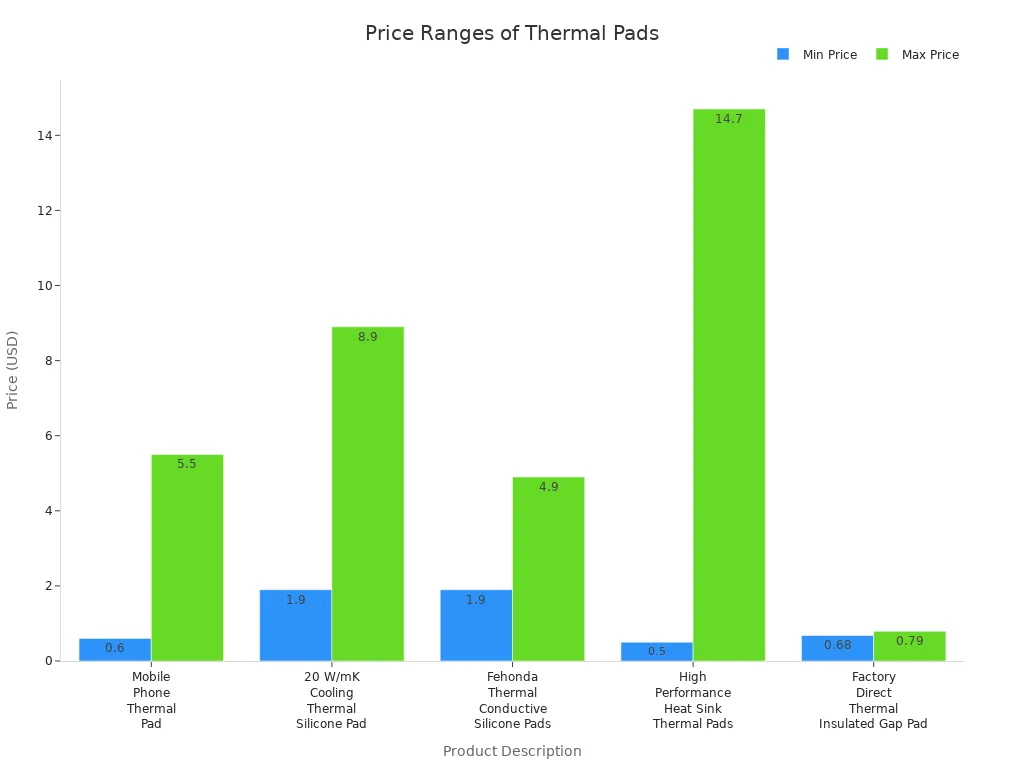
Graphite sheets cost more because they move heat better. You pay a medium or high price for graphite sheets, but they cool things faster. Silicone pads are the best deal if you need to fill gaps or cover bumpy spots.
Material | Conductivity (W/m·K) | Best Use Case | Cost Profile |
|---|---|---|---|
Silicone Pads | 0.8 – 8.0 | Gap filling, irregular surfaces | Most cost-effective |
Graphite Sheets | 600 – 1700 | Ultra-thin heat spreading | Mid-to-high |
You want your electronics to stay cool and last a long time. Graphite sheets give you the best cooling for your money. They move heat away very quickly. This is important in places like data centers, where chips must stay cool to work well.
Graphite sheets keep working for a long time. They do not break down or get hard like silicone pads can. This means you do not have to fix them as much. Silicone pads are good for filling spaces and stopping electricity, but they do not cool as well as graphite sheets.
Pick graphite sheets if your device gets very hot and you want it to last. Silicone pads are a smart choice if you want to save money or need to fill gaps. Thermal gap pads help protect your electronics and move heat. You get the best results when you pick the right material for your device.
Tip: Always check how well the material moves heat and how long it lasts before you buy. DASEN has many types of cooling materials for all kinds of devices.
Graphite sheets work in lots of devices. They help control heat in small spaces and fit odd shapes. You can put them in without extra steps. You can also change them during testing. They are good for making many devices at once and can save money for cheaper electronics. Graphite sheets block electromagnetic interference and help with cooling. You can use them in very thin things like phones and smartwatches. They handle heat from big or uneven spots and fit on flexible or special shapes.
Advantages | Disadvantages |
|---|---|
Easy installation with no secondary processing | Higher price point |
Suitable for complex shapes | |
Facilitates modification in R&D | |
Cost-effective for mass production |
You can bend them for special designs.
They help cool big or uneven places.
They block interference and move heat away.
Tip: Graphite sheets are great for devices that need strong cooling and thin parts.
Silicone pads fill spaces and keep electronics safe. You can put them in fast and use them again if you need to. These pads stop shaking and block electricity. They work well even when it is very hot or cold. You use them to cover bumpy spots and protect parts. Silicone pads have a set thickness, so you cannot change it. They do not move heat as well as thermal grease.
Pros | Cons |
|---|---|
Easy installation and reusability | Limited by pre-set thickness |
Vibration damping and electrical insulation | Higher thermal resistance than grease |
Stable performance under extreme temperatures |
You fill spaces and keep parts safe.
You use pads to stop shocks and block electricity.
They work well even in tough places.
Note: Silicone pads are best when you need to block electricity and fill spaces in your device.
Graphite sheet and silicone pad are different for cooling. Graphite sheets keep devices cooler because they move heat fast. These materials work well in devices that need quick heat transfer. Silicone pads are good for filling gaps and giving insulation. You should think about what your device needs before picking a material. DASEN has solutions for many uses.
EPP cooler boxes keep things cool for up to 72 hours.
Tiny air pockets in EPP slow down heat movement, so temperature changes only 1–2°C each hour.
EPP works well from -40°C to 120°C.
You can ask DASEN for help to pick the best materials for your electronics.
Graphite sheets move heat faster than other materials. They spread heat across the device quickly. This helps electronics stay cool and work better.
You use silicone pads when you need to stop electricity from passing through. They are also good for filling uneven spaces. Silicone pads protect parts and help absorb shocks.
Yes, you can use both together. This way, you get the good parts of each material. You can spread heat and fill gaps at the same time.
Think about what your device needs. Look at how much heat it makes, how much space you have, and if you need insulation. DASEN can help you pick the best material for your device.
DASEN products are safe for many types of electronics. They follow strict rules for quality. You get good cooling and protection for your devices.