
Views: 0 Author: Site Editor Publish Time: 2026-10-01 Origin: Site


Picking the right synthetic graphite sheet in 2026 means balancing conductivity, thickness, flexibility, and what your device needs. Bad material choices for 5G, EV batteries, or foldables can cause overheating, failure, or safety risks. Better manufacturing now shrinks the gap between high-end and budget grades of synthetic graphite sheets. The thermal management materials market hits USD 4.59 billion in 2026, growing at 6.30% CAGR through 2036. A graphite sheet's anisotropy affects how it works, so you must check your specific uses carefully. Graphite sheets offer light heat control for electronics, boosting cooling performance.
Pick a graphite sheet that balances heat spread, thickness, flexibility, and cost for your device.
Heat moves sideways in graphite sheets. Use this to pull heat away from hot spots.
Thicker sheets spread more heat but need more space. Choose thickness based on your room and heat load.
For foldable devices, pick flexible sheets that bend thousands of times without cracking.
EV battery packs need large coated sheets to stop short circuits and slow thermal runaway.
Test real samples before buying. Measure heat flow, adhesion, and bending to avoid failures.
High W/mK numbers do not always mean best results. Pick the grade that fits your design limits.
You need a fast way to pick the right grade for your product. This chart gives you a starting point. Look for your device type in the table below. Then read the detailed sections for more technical help.
Grade Category | In-Plane Conductivity (W/mK) | Key Feature | Best For |
|---|---|---|---|
Flagship | 1500 | Maximum heat spreading | High-end smartphones, GPUs |
Balanced | 800 – 1200 | High flexibility | Foldables, wearables, thin laptops |
Value | 400 – 700 | Cost-effective | LED lighting, consumer appliances |
Ultra-Thin | 700 – 1000 | Extreme thinness (<25 µm) | Space-constrained electronics |
This tier gives you the best thermal conductivity. You get 1500 W/mK in- to pull heat away from hot spots right away. The material uses a very pure synthetic graphite structure for top performance.
Models like the T68, T68A, T68AP, and T68APF reach this rating. They all have a density of 2.1 g/cm³ and a Z-axis conductivity of 5 W/m·K. The T68 can handle up to 400°C, while the T68APF works at 80-100°C for adhesive-backed designs.
These devices create intense heat in small spaces. A synthetic graphite sheet with high thermal conductivity moves heat away well. This stops throttling and keeps performance high during gaming or video work.
Not every device needs maximum conductivity. Many foldable designs need a flexible material that can bend without cracking. This grade balances heat spreading with mechanical strength.
This range still spreads heat well. The material can handle repeated folding cycles. This makes it great for moving designs where the sheet must flex thousands of times.
These devices have tight radius bends. A normal brittle sheet would break. Flexible graphite sheets ensure long-term reliability in these uses. They fit curved surfaces easily.
You do not always need top performance. For many products, standard thermal management using a graphite sheet is enough. This grade gives you a good mix of cost and function.
This is a solid starting point for synthetic graphite sheets. It handles moderate heat loads well. The cost is much lower than premium grades, making it good for high-volume production.
These devices have lower power density. Heat spreads over a larger area. A value-grade graphite sheet offers a low-cost solution. It extends product life without adding much cost.
Some designs need sheets thinner than 25 µm. These ultra-thin grades still deliver 700-1000 W/mK in-. They fit into very small gaps between parts. This is key for compact electronics where every micron matters.
Manufacturers like DASEN offer custom grades within these ranges. You can change thickness, adhesive, and dielectric coatings. For custom specs, check the sourcing section later in this guide.
Learning how a synthetic graphite sheet works helps you pick better materials. The making starts with polyimide film. Makers heat this film above 2800°C without oxygen. This step, called high-temperature pyrolysis, lines up carbon atoms in highly ordered layers. The result is a material with a nearly perfect crystal structure. That structure gives the sheet its great ability to spread heat.
Graphite spreads heat differently in different directions. This quality is called anisotropy. In a synthetic graphite sheet, heat moves along the surface at 1500 W/mK or more. Through the thickness, heat moves at only about 5 W/mK. This big difference affects how you use the material.
Picture the sheet like a highway system for phonons. Phonons are vibrations that carry heat in the crystal lattice. The in- direction is like a multi-lane freeway. Heat travels fast and well along this path. The through- direction is like a narrow back road. Very little heat goes that way. This design works great for electronics. Hot spots sit on one side of the sheet. The material spreads that heat sideways across a wide area. Then cooling parts like heat sinks or chassis panels take in the spread heat.
You have many choices for spreading heat. Each material has different strengths. Synthetic graphite sheets give the best in- heat flow among common thermal materials. Natural graphite flakes also move heat well, but they have more impurities and flaws. These problems scatter phonons and lower performance. Synthetic graphite sheets give more even results because the controlled making process removes most imperfections.
Copper also conducts heat well, around 400 W/mK. But copper weighs much more than graphite. A graphite sheet weighs about one-fourth as much as the same copper layer. Copper also conducts electricity, which can cause short circuits. Synthetic graphite sheets can have dielectric coatings for electrical insulation. For lightweight devices like smartphones and laptops, graphite sheets win easily.
The quality of the starting film sets the quality of the final product. Polyimide film is the base material. During pyrolysis, the film's polymer chains break down and rearrange. Carbon atoms line up into graphene-like layers. Higher processing temperatures make better alignment. This alignment directly controls the final heat performance.
The purity of polyimide film matters a lot. High-quality film has few foreign atoms. These impurities would mess up the crystal structure during graphitization. Makers like DASEN control this process carefully. Their ISO9001-certified production ensures every batch is the same. This consistency is important for high-volume electronics making. You need predictable performance across millions of units. A synthetic graphite sheet from a trusted supplier gives that reliability every time.
The result of this process is a material with high heat flow and surprising flexibility. You can bend it around corners. You can cut it into complex shapes. You can laminate it with adhesives or insulating films. This versatility makes synthetic graphite sheets the top choice for modern thermal management needs.
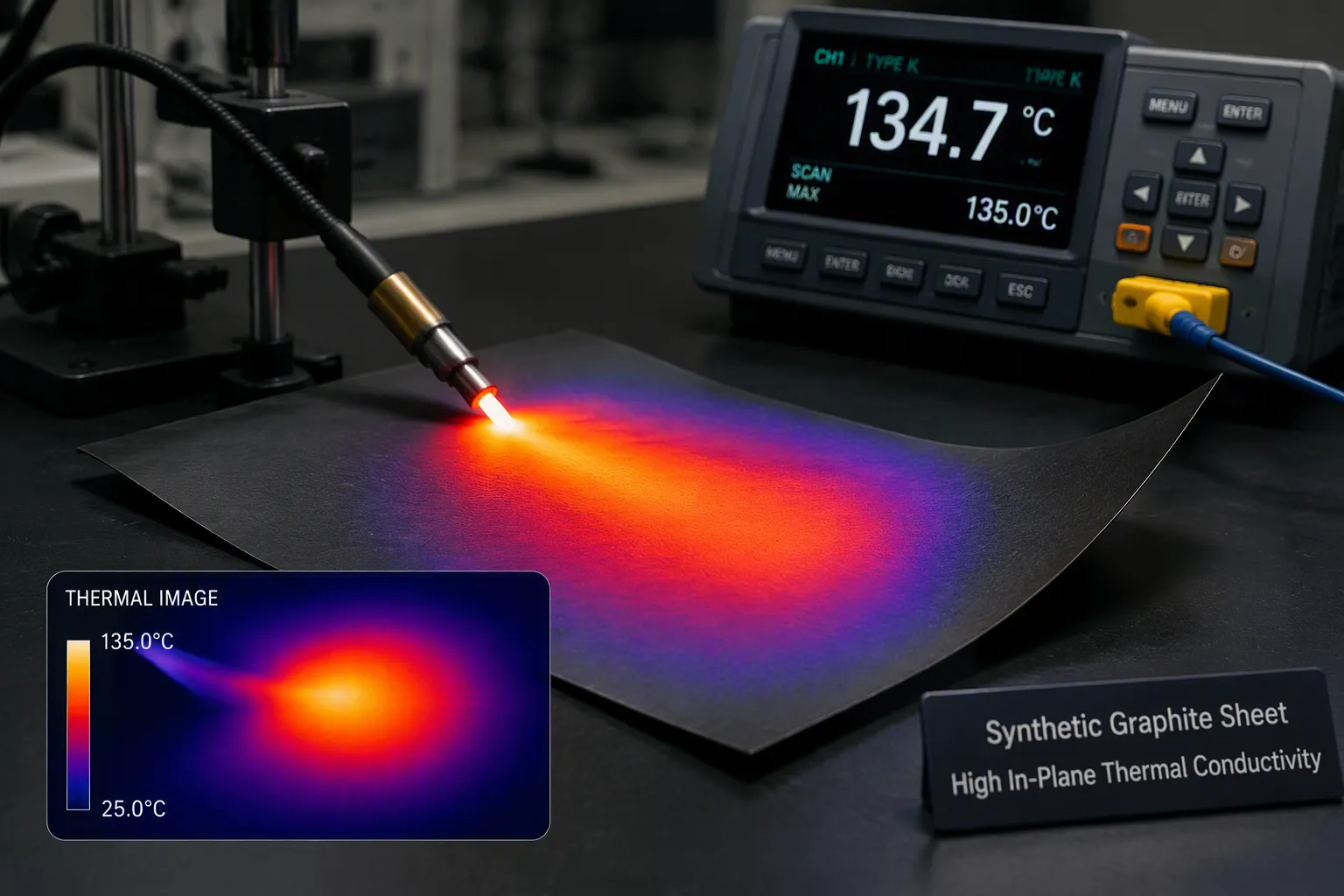
When you pick a graphite sheet, the numbers on a datasheet only show part of the picture. Those values come from perfect lab tests with ideal surfaces. Your real device has adhesives, mounting pressure, air gaps, and rough surfaces. All these things change how well the sheet manages heat. DASEN's ISO9001-certified process makes sure each batch matches the specs. This consistency matters for making many units. You need dependable results across thousands of products. A tiny change in material quality can cause big issues in the field.
Heat moves along the sheet surface much faster than through its thickness. This is the main feature of a synthetic graphite sheet. The in- conductivity reaches 1500 W/mK. This high thermal conductivity lets you pull heat away from a small hotspot. The heat spreads across a wide area. Then a heatsink or chassis can remove it. Think of the sheet as a road for heat. The main road runs along the surface. Only a small path goes through the thickness. This is why you want to place the sheet so the main heat path stays in the in- direction. The layered crystal structure guides phonons along the .
But you cannot ignore the cross- direction completely. Some uses need heat to move through the sheet. For example, when you stack multiple sheets or mount a part directly on top. The through- value sits near 5 W/mK. This is low but still helpful. You need to think about the thermal path from the heat source to the sheet's surface. Good contact pressure lowers the resistance at this interface. Without enough pressure, air gaps create a barrier. A thermal interface material can help fill those gaps. The through- direction becomes important in multi-layer designs.
Thicker sheets spread more heat. But they take up more space inside your device. This trade-off matters in ultra-thin products. A thicker sheet has more cross-sectional area for heat to flow. This lowers the thermal resistance along the sheet. But you must fit the sheet into a tight gap. You also need to think about flexibility. Thicker sheets bend less easily. For foldable devices, a thin flexible sheet is better. The minimum bend radius becomes larger as thickness increases. You must balance these two needs for your specific design.
These four thicknesses cover most uses. The 17µm sheet works for very tight spaces. It still delivers good heat spreading. The 25µm sheet is a common choice for smartphones. It balances performance and thickness well. The 40µm sheet handles higher heat loads. You find this in laptops and tablets. The 70µm sheet offers the best heat spreading. Use this for large-area cooling in EV battery packs. Each thickness has a specific role in the market. Your choice depends on the available space and the heat load you need to manage.
A bare graphite sheet conducts electricity. It can cause short circuits if it touches exposed parts. You can add a dielectric coating to fix this problem. Coated sheets provide electrical insulation. They also prevent oxidation over time. The coating adds a small amount of thermal resistance. But this trade-off is worth it for safety. Many EV applications require coated synthetic graphite sheets. The coating thickness typically ranges from a few microns to tens of microns. You can choose the right level of insulation for your voltage needs.
The adhesive layer between the sheet and the part adds resistance. Standard acrylic adhesives have low thermal conductivity. They can block heat flow. You need thermally conductive adhesives for good performance. These adhesives contain ceramic fillers. They help heat pass through the bond line. The adhesive thickness also matters. A thinner layer gives lower resistance. But a very thin layer may not bond well to rough surfaces. You must test the adhesive with your specific substrate to ensure good wetting and coverage.
Graphite sheets handle high temperatures well. Some grades work up to 400°C. But the adhesive limits the overall range. Standard adhesives degrade above 100°C. For high-temperature uses, choose a sheet without adhesive or with a high-temperature adhesive. Over time, repeated heating and cooling cycles can affect performance. The material may lose some flexibility. DASEN's manufacturing process creates stable sheets that resist aging. Proper storage and handling also extend the material's life. Check the datasheet for the maximum continuous operating temperature of your chosen grade.
Different devices put different needs on your material choice. A smartphone needs to be very thin. An EV battery pack needs to cover a large area and stay electrically safe. A 5G base station needs to stay stable at high temperatures for a long time. Matching your device type to the right grade saves time and money.
Modern phones make a lot of heat from processors, cameras, and 5G radios. You have almost no vertical space to handle that heat. Every tiny bit of thickness matters when your whole device is under 8mm. This fact shapes your material choice from the start.
You face a direct trade-off. A thicker graphite sheet spreads more heat but takes up precious Z-height. A thinner sheet fits tight gaps but moves less heat. For most flagship phones, a 25µm sheet offers the best balance. It gives strong in- conductivity around 1500 W/mK while adding very little thickness. Ultra-thin grades below 25µm work for wearables where space is even tighter. These thinner options still provide 700-1000 W/mK, which handles moderate heat loads well.
The placement of the sheet matters just as much as its thickness. You want the sheet to connect the hotspot and the chassis or heat spreader. This creates a clear path for heat to travel. You also need to think about the adhesive layer. A thermally conductive adhesive stops the bond line from becoming a blockage. Test your stack-up with real parts. Datasheet values assume perfect contact. Your actual assembly includes pressure, tolerances, and surface roughness that change performance.
Electric vehicle batteries produce heat across large surfaces. Cells generate heat unevenly during fast charging and high discharge. Without proper spreading, hot spots form. These hot spots speed up cell damage and reduce cycle life. A synthetic graphite sheet can spread heat across the whole pack surface, keeping temperatures more even.
Thermal runaway remains the biggest safety concern for EV batteries. One cell overheating can trigger nearby cells. A graphite sheet helps by moving heat away from a failing cell. This slows down spread and gives the battery management system time to react. Even temperature also extends cycle life. Cells that stay within a narrow temperature range degrade more slowly. You want a sheet that covers the full cell area. Large-format sheets, often 70µm thick, provide the cross-sectional area needed for effective spreading across wide surfaces.
Bare graphite conducts electricity. In a battery pack, this creates a short-circuit risk. Cell terminals and busbars carry high voltage. A conductive sheet touching both creates a dangerous path. You must use a coated sheet with dielectric properties. The coating provides electrical insulation while keeping thermal performance. This coating adds a little thermal resistance, but the safety benefit far outweighs this cost. Always check the coating's voltage rating against your pack's maximum voltage. Also confirm the coating can handle the operating temperature range of your battery system.
Base stations run all the time in outdoor environments. They face temperature swings from freezing winters to scorching summers. Power electronics inside generate a lot of heat that must move away efficiently. Your material must work reliably for years without breaking down.
Standard acrylic adhesives fail above 100°C. For base station electronics that run hot, you need a different approach. Choose a graphite sheet without adhesive or with a high-temperature adhesive rated for your operating range. Some grades handle up to 400°C, giving you plenty of margin. The graphite itself resists aging well. Its crystal structure stays stable through repeated heating and cooling cycles. This longevity matters for equipment designed to run for a decade or more.
RF interference is not usually a problem with graphite. The material does not create or attract electromagnetic noise in most cases. However, you must think about grounding and shielding separately. Graphite sheets do not replace your shielding plan. They handle heat, not electromagnetic compatibility. Plan your grounding paths and shield cans separately from your thermal solution.
The right material depends on your specific application. A smartphone needs thinness. An EV pack needs safety and coverage. A base station needs durability. Match the grade to the demand, and you will get reliable cooling performance across the product's lifetime.
The thermal management field changes fast. New materials come out every year. Some offer real improvements. Others promise more than they can deliver. You must tell real progress from marketing hype. This section helps you see the difference.
Graphene gets lots of buzz. Makers add small amounts to their products. They claim big performance gains. The truth is more complicated. Pure graphene moves heat extremely well. But adding it to a useful sheet on a large scale is still hard. Most graphene-enhanced products contain only a tiny share of graphene. This small amount does not change how the whole sheet works. The base material still does most of the job.
Ask tough questions when you see graphene claims. Ask for test results from independent labs. Ask how the graphene fits into the structure. Ask if the better performance is worth the higher price. In most cases, the extra cost outweighs the real benefit. A good standard synthetic graphite sheet already works very well. For most consumer electronics, you will not see a difference. Spend your money on other design upgrades. Only think about graphene options when you have tried standard choices and still need more power.
Production methods keep getting better. Chemical vapor deposition, or CVD, lets makers create graphitic layers with fewer flaws. This process builds a more perfect crystal structure. Fewer flaws mean less phonon scattering. Heat moves faster through the material. These advances push in- conductivity past 1800 W/mK. That number is more than most devices need today. But the trend matters for future products with higher power needs.
Annealing quality is also improving. Better temperature control during graphitization gives more consistent results. The crystal alignment becomes more uniform across the whole sheet. This consistency means predictable performance in your product. You can design with smaller safety margins. You can trust that every batch works like the last one. For large-scale production, this reliability matters more than a small conductivity boost. DASEN puts a lot of money into these areas. The company holds over 10 patents for production methods and material improvements. This research helps you through better products at steady prices.
Environmental concerns shape buying choices. Electronics makers face pressure to cut waste. Graphite sheets offer some benefits here. The material itself is stable and safe. It does not release harmful compounds during use. But recycling is still hard. Graphite sheets often stick to adhesives and other materials. Separating these layers takes work. Some makers now design for easier take-apart. They use release liners that peel off cleanly. They avoid permanent bonding when they can.
DASEN works on reducing production waste. Better cutting methods reduce scrap. More efficient processes use less energy per square meter. These improvements lower costs. They also shrink the environmental impact of synthetic graphite sheets. When you check suppliers, ask about their green practices. Ask about waste reduction efforts. Ask if their products can be recycled. These factors affect your own environmental reports. They also affect long-term supply stability. Makers who invest in sustainable methods prepare for future rules. You gain by working with partners who plan ahead.
The market for graphite sheets keeps changing. Graphene hype will fade. Real manufacturing gains will stay. Sustainability will become a normal requirement. You should watch these trends. They affect product quality, cost, and supply. Choose suppliers who invest in real innovation. Your thermal management plan depends on their progress.
Finding the right supplier matters just as much as picking the right material. A great graphite sheet from an unreliable source causes production delays and quality surprises. You need a partner who can deliver steady material at the volume you need. This section helps you check suppliers, understand costs, and test materials before you commit.
Start your supplier search by looking at their quality certifications. ISO9001 certification shows they follow international quality management standards. This means they record their processes and track quality numbers. Ask about their testing methods. Do they test every batch or only samples? What tolerances do they hold? A supplier who cannot answer these questions clearly will likely cause problems later.
Capacity matters for your production schedule. A small supplier might offer great prices but cannot grow with you. Check their factory space and yearly output. Ask about their lead times for standard and custom orders. A reliable supplier keeps enough stock to ship samples quickly. They also tell you honestly about production timelines. You want a partner who reports delays early, not after the deadline passes.
DASEN is a good example of a mid-to-large scale manufacturer. Founded in 2011, the company runs a workshop covering over 10,000 square meters. Their yearly production capacity reaches 6 million square meters of synthetic graphite sheet. This scale means they can handle both prototyping and high-volume orders without losing quality.
DASEN employs around 170 people and holds more than 10 invention patents. Their ISO9001 certification shows their commitment to steady quality. They serve industries from consumer electronics to new energy vehicles. When you contact them, you can request custom grades within their standard ranges. Their engineering team helps you match the right material to your application. This support proves valuable when you face unusual thermal challenges.
Pricing for synthetic graphite sheets varies widely based on grade and thickness. You can expect to pay roughly $5 to $50 per square meter in 2026. The exact price depends on several factors. Higher thermal conductivity costs more. Thinner sheets need more precise manufacturing. Dielectric coatings and adhesive layers add cost. Custom sizes and shapes also raise the price per unit area.
Value grades with 400-700 W/mK conductivity fall at the lower end of this range. These suit LED lighting and consumer appliances where cost matters most. Balanced grades with 800-1200 W/mK sit in the middle. Flagship grades reaching 1500 W/mK command the highest prices. For ultra-thin sheets under 25µm, expect prices near the top of the range. The manufacturing difficulty drives this cost. Always request quotes from multiple suppliers. Prices vary based on their production efficiency and material sourcing.
Never skip sample testing before placing a volume order. Datasheet values come from ideal lab conditions. Your real application includes adhesives, mounting pressure, and surface roughness. These factors change how the material performs. A sample test shows the actual thermal behavior in your specific assembly. This step saves you from costly redesigns later.
Request samples from at least two suppliers. Test them under identical conditions. Compare the results against your thermal budget. This validation process takes time but prevents expensive mistakes. A material that looks perfect on paper might fail in your device. Physical testing gives you confidence before you commit to large orders.
Run three key tests on your samples. First, measure thermal impedance using the ASTM D5470 standard. This test shows how well heat passes through the material under controlled pressure. It reveals the real-world thermal resistance of your stack-up. Second, perform an adhesion peel test. This confirms the adhesive bonds properly to your substrate. Weak adhesion causes delamination and performance loss over time. Third, test bending fatigue if your design requires flexibility. Fold the sample repeatedly to simulate real use. Check for cracks or conductivity loss after thousands of cycles.
These tests give you data you can trust. They reveal differences between suppliers that datasheets hide. A cheaper material might fail your bending test. A premium grade might not improve thermal performance enough to justify its cost. Testing answers these questions with evidence, not guesswork. Your thermal management solution depends on this validation. Take the time to test properly, and you will avoid field failures that damage your reputation.
Use this five-step checklist to pick your final material:
Define your thermal budget. Calculate the W/mK needed for your hotspot.
Know your space limits. Find out the thickness and flexibility you can use.
Check electrical safety. Decide if you need insulation or grounding.
Pick a sheet that fits your temperature range and where it will work.
Test real samples from at least two suppliers.
The best synthetic graphite sheets are not the ones with the highest conductivity. They meet all your design limits—thermal, mechanical, electrical, and cost—without adding extra work. Good thermal management balances performance with cost.
Ready to pick your material? Email DASEN at export01@szdasen.com or go to thermalgraphite.com to ask for a custom sample kit and datasheets. If you are not sure about your shape, ask a thermal engineer to model the heat path before you buy.
Synthetic graphite sheets are made by heating polyimide film above 2800°C without oxygen. This process creates a cleaner and more uniform crystal structure than natural graphite. You get steadier thermal performance and fewer impurities in every batch.
Yes, you can cut most synthetic graphite sheets with a sharp blade or die cutter. The material does not splinter easily. For complex shapes, ask your supplier for custom-cut pieces.
You balance heat spreading with the space inside your product. A 25µm sheet works well for smartphones. Thicker sheets spread more heat but need more room. A 70µm sheet fits large-area uses like EV battery packs.
Standard acrylic adhesives block heat flow. You need a thermally conductive adhesive with ceramic fillers. This lets heat pass through the bond line. A thinner adhesive layer lowers thermal resistance.
Use the ASTM D5470 standard to measure thermal impedance under real pressure. Also run an adhesion peel test and a bending fatigue test if your design folds. These three tests show real-world performance that datasheets miss.
No, the best sheet fits your design limits. High conductivity costs more and may not help if space or flexibility needs limit thickness. A 400-700 W/mK sheet often works fine for LED lighting and appliances.