
Views: 0 Author: Site Editor Publish Time: 2026-03-16 Origin: Site


You see high thermal conductivity in graphite because of its special crystal structure and anisotropic science properties. The layers of carbon atoms in graphite help thermal science energy move quickly and easily. This makes graphite a great choice for thermal management in many areas. The science behind graphite gives you a material that handles heat better than most metals. You find graphite sheet in Thermal Conductivity important for devices that need strong thermal science control. DASEN uses new science and advanced technology to make graphite sheets that are leaders in thermal science innovation.
Graphite sheets are great at moving heat because of their special layers. Heat travels fast along these layers.
The layers have strong covalent bonds that help heat move. Weak forces between layers make heat move slower there.
To get the best results, line up the graphene layers with the heat source. This helps spread heat better.
DASEN sells both synthetic and natural graphite sheets. Each type is made for different ways to control heat.
Synthetic graphite sheets move heat better and can be changed to fit needs. Natural sheets cost less and work well for simple uses.
Graphite sheets are much lighter than metals like copper or aluminum. This makes them good for things you carry around.
Graphite has anisotropic properties, so it moves heat better in one direction. This is important for good heat control.
Picking graphite sheets with fewer defects and less dirt gives better heat performance and makes them last longer.
Graphite sheets have a special structure. Many graphene layers are stacked on top of each other. Each layer has carbon atoms in a hexagon shape. These layers are the main part of graphite sheets. How these layers stick together changes how heat moves.
Inside each layer, covalent bonds are very strong. These bonds hold the carbon atoms close together. These strong bonds help heat move fast along the layers. Heat travels easily in the same direction as the layers. The atoms shake and pass energy quickly. In this direction, thermal conductivity can be as high as 1500-2000 W/(m·K). This makes graphite sheets great for moving heat away fast.
Between the layers, van der Waals forces are weak. These weak forces keep the layers together but do not help heat move. When heat tries to go across the layers, it moves much slower. The thermal conductivity here is only 5-10 W/(m·K). The weak bonds make more phonon scattering, which slows heat down. This big difference means graphite sheets move heat better along the layers than across them.
Tip: Always think about heat direction when using graphite sheets. Line up the graphene layers with the heat source for best results.
How the atoms are arranged in graphite sheets matters a lot. The graphene layers stack in a neat order. This neat stacking helps heat move smoothly along the layers. Science studies show some key facts:
Thermal conductivity is much higher along the carbon layers than between them.
Strong covalent bonds in the layers help phonons move well, so heat moves better.
Weak van der Waals forces between layers cause more phonon scattering, so heat moves slower across layers.
Crystal defects like missing atoms or dislocations make more phonon scattering and lower thermal conductivity.
Impurities in the crystal mess up the structure and stop phonons, lowering thermal conductivity.
The way the atoms are arranged changes how well graphite sheets handle heat. If you pick graphite sheets with fewer defects and impurities, they work better. The structure and stacking of graphene layers make graphite sheets a top pick for managing heat in electronics and other fields.
When you study a graphite sheet in thermal conductivity, you see science and smart design working together. The special structure of graphite lets heat move fast and easily. This material helps fix heat problems in electronics, energy, and transportation.
There are two main ways heat moves in a graphite sheet in thermal conductivity: phonon movement and electron flow. These ways explain why graphite sheets work so well.
Phonons are tiny vibrations that carry heat through the graphite sheet in thermal conductivity. When you use a graphite sheet, phonons move quickly along the layers. This helps heat spread fast. Here are some key points:
Heat moves quickly to the device’s shell and frame through the surface of the graphite sheet in thermal conductivity.
The surface of the graphite sheet increases infrared radiation, which helps release heat.
The large surface area of the graphite sheet in thermal conductivity helps get rid of hotspots fast.
Phonon movement depends on how atoms vibrate and interact. In a graphite sheet, strong bonds in each layer help phonons move with little resistance. This makes the graphite sheet in thermal conductivity a great choice for cooling.
There are different types of phonon movement. Phonon Poiseuille flow and diffusive phonon transport change how heat moves. In diffusive transport, resistance comes from random scattering, which spreads heat evenly. In Poiseuille flow, boundaries and special scatterings change how fast and far phonons move. The shape and size of the graphite sheet in thermal conductivity can change how well phonons carry heat.
Electrons also help move heat in a graphite sheet in thermal conductivity. The way electrons and phonons interact is important. When electrons move, they bump into phonons and help carry heat. This process adds to the total conductivity of the graphite sheet.
The rate of momentum transfer to the boundary affects conductivity. If the graphite sheet in thermal conductivity has a special shape or size, it can change how well electrons and phonons work together. This means you can design graphite sheets for the best performance.
Graphite sheets do not move heat the same way in every direction. You need to know how this works to use a graphite sheet in thermal conductivity the right way.
When you measure conductivity in a graphite sheet, you see a big difference between the in- (parallel) and through- (perpendicular) directions. The table below shows this difference:
Direction | Thermal Conductivity (W/(m·K)) |
|---|---|
In- | 1500-2000 |
Through- | 5-10 |
You get much higher conductivity when heat moves along the layers (in-). If heat tries to move across the layers (through-), the conductivity drops a lot. This is why you should always place the graphite sheet in thermal conductivity so the layers line up with the heat path.
DASEN leads in making advanced graphite sheet in thermal conductivity products. You can pick synthetic graphite sheets or natural graphite sheet options, each with special features.
DASEN uses advanced carbon fiber materials to boost conductivity. You get properties you can change to fit many uses. DASEN’s synthetic graphite sheets offer:
Higher conductivity for tough jobs.
Smart heating systems that let you change temperature fast.
Energy-efficient and environmentally friendly designs.
DASEN also uses new carbon fiber composite heating plates. These give you better control over heat management. The way carbon fibers are arranged helps control thermal expansion, so your devices stay stable.
You can pick a natural graphite sheet for affordable and reliable thermal management. DASEN’s natural graphite sheet products give you:
Excellent conductivity for moderate heat needs.
A good balance between performance and price.
Solutions for electronics, lighting, and energy storage.
DASEN uses careful manufacturing methods for each natural graphite sheet. Slow cooling and special molding reduce stress and keep the sheet stable. The choice of resin and polymer matrix helps each natural graphite sheet keep its size and shape, even when temperatures change.
The table below compares synthetic and natural graphite sheet options:
Type of Graphite Sheet | Thermal Conductivity | Performance Characteristics |
|---|---|---|
Synthetic Graphite Sheets | Higher | Customizable properties suitable for various applications |
Natural Graphite Sheets | Excellent | Cost-effective, used for moderate thermal management |
You can trust DASEN’s natural graphite sheet and synthetic graphite sheet in thermal conductivity for top results. DASEN’s focus on innovation, quality, and customer satisfaction makes their products a smart choice for your thermal management needs.
Tip: Pick the right graphite sheet in thermal conductivity for your project. Synthetic graphite sheets give you higher performance, while a natural graphite sheet offers great value for everyday uses.
Graphite sheets have anisotropic properties because of how atoms are arranged. Anisotropy means a material acts differently in different directions. In graphite sheets, the way nanocrystallites and texture line up controls this. Thermal and electrical conductivity change based on which way you measure. If you measure along the rolling , you get one result. If you measure across it, you get another. This happens because carbon atom layers stack in a special way. When the graphene layers are parallel, thermal and electrical conductivities are high. Both properties depend on the direction you measure in the crystal.
Think of anisotropy like a road with lanes going different ways. Some lanes let cars go fast, others are slow. In graphite, heat and electricity move fast along the layers. They move much slower across the layers. This is why graphite is good for thermal management.
Thermal and electrical conductivities are very different in each direction. In- thermal conductivity is much higher than through-. Heat moves fast along the layers but slow across them. Electrical conductivity works the same way. It is high along the layers and low across them.
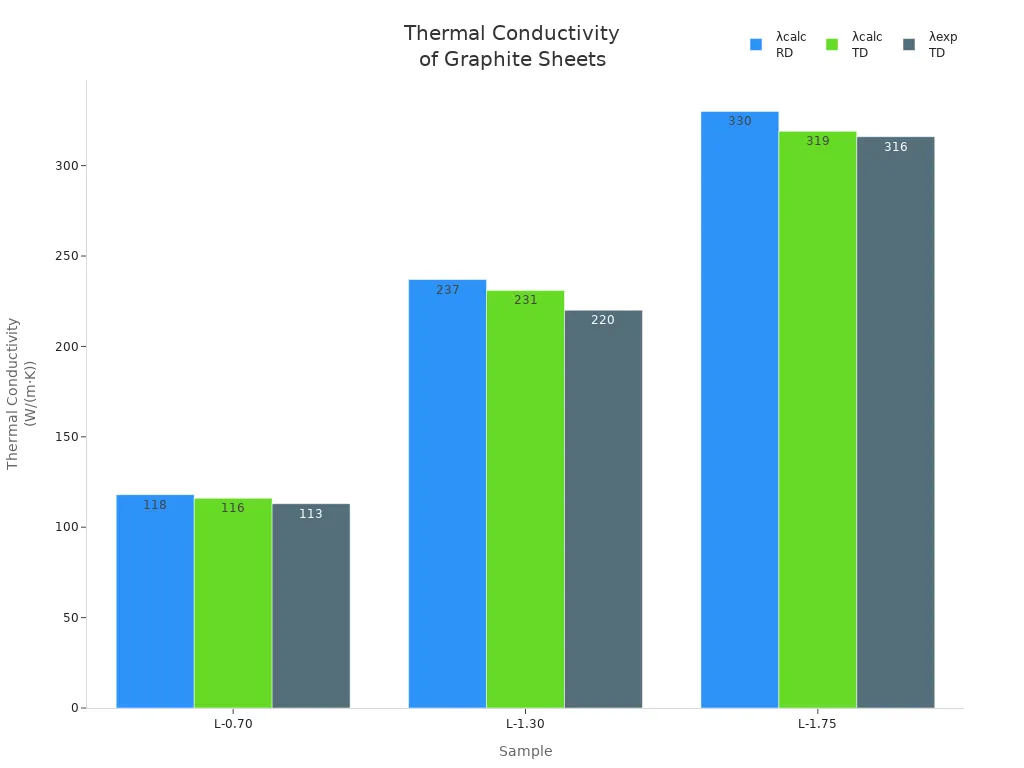
The table below shows how thermal conductivity changes in graphite sheets:
Samples | λcalc, W/(m·K) | <λexp>, W/(m·K) |
|---|---|---|
L-0.70 | 118 (RD), 116 (TD) | 113 (TD) |
L-1.30 | 237 (RD), 231 (TD) | 220 (TD) |
L-1.75 | 330 (RD), 319 (TD) | 316 (TD) |
The calculated and experimental values are close. RD means rolling direction, and TD means transverse direction. Both directions show high values, but there are small differences because of anisotropy.
Special methods are used to measure anisotropic conductivities in graphite sheets. The Light Flash Method and Transient Plane Source method are most common. These methods show how well heat and electricity move in different directions.
Method | Equipment Used | Measurement Direction |
|---|---|---|
Light Flash Method | NETZSCH LFA467 | In- |
Transient Plane Source | Hot Disk TPS 2500S | In- and through- |
The Light Flash Method checks in- thermal conductivity. The Transient Plane Source method checks both in- and through-. These methods test exfoliated natural graphite sheets. They also compare parallel and through- conduction.
Anisotropic properties change how graphite sheets work in real devices. You must think about shape, orientation, and contact area. These things affect thermal and electrical conductivity. For best thermal performance, line up the layers with the heat path.
The table below shows how anisotropy affects graphite sheets:
Aspect | Findings |
|---|---|
Thermal Conductivity | Conductivity and anisotropy depend on shape, orientation, and contact area of TEG mesoparticles. |
Mechanical Properties | Increased density leads to larger coherent scattering regions and reduced misorientation angles. |
Anisotropy Coefficients | Anisotropy coefficients varied from 1.00 to 1.16, correlating with specific electrical conductivity. |
Density Impact | Thicker foils showed increased density effects on thermal and mechanical properties. |
Thicker exfoliated natural graphite foils have higher density. This gives better thermal and electrical conductivities. The anisotropic nature lets you design devices that spread heat in one direction and block it in another. Exfoliated natural graphite is used for batteries, electronics, and other thermal management materials because of these properties.
Tip: Always check the direction of the graphite sheet before using it. This helps you get the best electrical and thermal performance for your device.
You can use graphite sheets to solve tough heat problems in electronics and energy storage. Anisotropic properties let you control how heat and electricity move. You get high in- thermal conductivity and strong electrical conductivity along the layers. You also get lower through- thermal and electrical conductivity across the layers. This makes exfoliated natural graphite a smart choice for many uses.
People use metals like copper and aluminum to manage heat. These metals move heat well, but graphite sheets have special benefits. Graphite sheets move heat even better than these metals. They are also much lighter, which helps in many ways.
Here is a table that shows how graphite sheets and metals compare:
Material | Thermal Conductivity (W/(m·K)) | Weight Comparison |
|---|---|---|
Graphite | 1500-2000 | 25% lighter than aluminum, 75% lighter than copper |
Aluminum | ~205 | Baseline weight |
Copper | ~400 | Baseline weight |
Stainless Steel | ~16-25 | Heavier than graphite |
Silver | ~406 | Heavier than graphite |
You can see graphite sheets move heat much faster than aluminum, copper, or stainless steel. Graphite sheets are also lighter than these metals. For example, graphite sheets are 25% lighter than aluminum and 75% lighter than copper. This makes them a good pick for things like smartphones or laptops, where weight matters.
Graphite sheets also have lower thermal resistance. They have 40% less thermal resistance than aluminum and 20% less than copper. This means heat leaves your device faster, so it stays cool and safe.
Tip: If you want your device to be lighter and cooler, use graphite sheets instead of metals.
You might wonder how graphite sheets compare to other carbon materials. Graphite sheets are special because they mix high thermal conductivity, flexibility, and low weight. You can cut them into many shapes and sizes. This helps them fit in different devices.
Here is a table that shows the main features of graphite sheets:
Feature | Description |
|---|---|
High Thermal Conductivity | Ranges from 300 to 1500 W/(m·K), so heat moves away quickly. |
Flexibility | You can cut and shape graphite sheets for many uses. |
Lightweight | Graphite sheets add very little weight, which is important for slim and portable devices. |
High-Temperature Resistance | Graphite sheets work well up to 400°C in oxidizing environments, so you can use them in tough jobs. |
Other carbon materials, like carbon fiber or amorphous carbon, do not move heat as well as graphite sheets. Graphite sheets spread heat better and give you more ways to design your device. They also work at high temperatures and keep your device light.
Note: If you need something flexible and good at moving heat, graphite sheets are a great choice.
Now you can see why many companies use graphite sheets for thermal management. You get strong performance, low weight, and many design options.
Defects and impurities can change how well a graphite sheet moves heat. If a graphite sheet has more defects or unwanted stuff, it does not work as well. Defects break the smooth path for heat to travel. Impurities block the way for heat and electricity. This means the graphite sheet cannot cool your device as fast.
Here is a table that shows how defects and impurities affect graphite sheets:
Factor | Effect on Thermal Conductivity |
|---|---|
Impurity Content | Reduces thermal conductivity |
Crystal Defects | Reduces thermal conductivity |
Porosity | Lowers electrical conductivity |
Disorientation | Lowers electrical conductivity |
You can see these effects in other ways too: Defects in graphene lower thermal conductivity. Defects also make the graphite sheet weaker. When there are more defects, transport properties drop.
If you want the best performance, pick graphite sheets with fewer defects and less impurity.
Temperature changes can make a big difference in how a graphite sheet works. At low temperatures, tiny vibrations called phonons have more energy. These phonons can travel farther without bumping into each other. This lets heat move faster through the sheet.
When the temperature gets too high, phonons start to bump into each other more. These bumps slow down the movement of heat. The path for heat becomes shorter, so the graphite sheet cannot carry heat as well. The best thermal conductivity happens at lower or medium temperatures.
Tip: If you use graphite sheets in very hot places, check if the thermal conductivity still meets your needs.
How you make a graphite sheet changes its thermal conductivity. Synthetic graphite sheets have a very even structure and fewer impurities. This helps them move heat better. Natural graphite sheets cost less, but they may not work as well for tough jobs.
You can also change how well a graphite sheet works by making it denser or adding special materials. For example, adding thermosetting phenolic resin can help. When you make the sheet denser, the bonds between graphite flakes get stronger. This lets heat move faster.
Here is a list that shows how forming density affects thermal conductivity:
If you raise the forming density from 1.0 to 1.4 g/cm³, thermal conductivity goes from 0.867 to 2.142 W/(m·K).
This is a 1.47 times improvement.
Stronger bonds between flakes help heat move better.
You should pick the right manufacturing method for your needs. If you want the highest thermal conductivity, look for synthetic graphite sheets with high density and few impurities.
You use electronics every day. These devices can get hot when you use them. If they get too hot, they might slow down or stop working. Graphite sheets help keep electronics cool. You can find them in things like smartphones and laptops. They move heat away from hot spots fast. This helps your device stay safe and work well.
The table below shows how graphite sheets help:
Metric | Value Before | Value After | Improvement |
|---|---|---|---|
Steady-state touch temperature | N/A | 3.2°C | N/A |
Max junction temperature | N/A | <1°C | N/A |
3DMark—Sling Shot Extreme score | 3,823 | 12.4% increase |
When you use graphite sheets, your device feels cooler. The inside parts do not get too hot. You also get better performance. DASEN’s graphite sheets help your electronics run faster and safer.
Tip: Put graphite sheets close to the heat source for the best cooling.
Batteries need to be safe and work well. Graphite sheets help batteries last longer and stay cool. You can find them in lithium-ion batteries and other energy storage systems. They spread heat so batteries do not get too hot.
Here is how graphite sheets help with energy storage:
Application | Effectiveness Description |
|---|---|
Lithium-ion batteries | Recycled graphite works well in energy storage. It helps batteries last longer. |
Biodegradable composites | These materials help control heat and save energy in renewable energy. |
Solar thermal applications | Biodegradable graphite-reinforced composites store heat well. |
Compact electronic devices | Good thermal performance helps control temperature and saves energy. |
With graphite sheets, batteries are safer and use energy better. DASEN’s products help power your devices and vehicles safely.
Many industries use graphite sheets. They help cool machines and keep them working. You can find them in:
Cellular phones
Digital video cameras
Digital still cameras
PCs and computer parts
Semiconductor manufacturing equipment
Optical communications equipment
Graphite sheets often work better than copper. They are flexible and easy to shape. You can use them to lower thermal contact resistance in circuits and power modules. DASEN’s graphite sheets give you good thermal management for all these uses.
Note: DASEN’s careful production and quality checks make sure you get the best graphite sheets for your needs.
When a company tries new ideas and uses new technology, it can make big progress. DASEN is a leader in thermal management because it spends a lot of time on research and development. This helps your devices stay cool and work well.
DASEN owns many patents for its special graphite sheet technology. These patents show that DASEN cares about making new and better products. You can see how many patents DASEN has in the table below:
Type of Patent | Quantity |
|---|---|
Practical Patents | |
Invention Patents | 10+ |
DASEN keeps making its designs better by using the latest science. Each patent means DASEN found a new way to fix a problem or improve a product. You can trust that DASEN’s graphite sheets use smart methods that other companies cannot copy.
DASEN can make a lot of graphite sheets every year. The company can produce up to 6 million square meters of graphite sheets each year. This means you can always get high-quality materials, even for big jobs. The factory is over 10,000 square meters and has modern machines to keep quality high.
DASEN follows ISO9001 rules for quality. This means you get safe and good products.
You can find DASEN’s graphite sheets in many industries. Electronics, energy, and transportation companies use DASEN because they want products they can trust. DASEN’s graphite sheets are in smartphones, batteries, and medical devices.
The DASEN team works hard to make things better. You get the benefits of their hard work and skill. When you choose DASEN, you pick a partner that cares about new ideas, quality, and your success.
You get products that are protected by patents.
You receive materials made in a big, modern factory.
You enjoy solutions trusted by top companies everywhere.
You can count on DASEN to give you advanced thermal management for your needs.
Graphite sheets can move heat very well because of their strong carbon bonds in each layer and their special stacked structure. These sheets send heat fast in one main direction. This makes them great for things like electronics, cars, and s.
Graphite’s anisotropic properties help you guide heat where you want it. This keeps devices safer.
DASEN uses new ways to make graphite sheets. They do a lot of research to give you good and dependable products.
As technology gets better, people will use graphite sheets in even more areas.
See how graphite sheets might help with your next project!
Graphite sheets have strong carbon bonds in each layer. Heat moves fast along these layers. This helps your device stay cool.
You put graphite sheets close to hot parts. They spread heat away from chips and batteries. This keeps electronics safe and helps them work better.
Property | Description |
|---|---|
Flexibility | You can bend, cut, or shape graphite sheets. They fit many devices and designs. |
You can use graphite sheets instead of copper or aluminum. Graphite sheets are lighter and move heat faster in one direction.
Electronics
Energy storage
Transportation
Medical devices
You can find DASEN graphite sheets in phones, batteries, and machines.
Pick synthetic sheets if you need high performance. Choose natural sheets if you want to save money. Both types help control heat.
You can use graphite sheets in places up to 400°C. They do not melt and keep their shape. This makes them good for hard jobs.
DASEN has many patents and uses strict quality rules. You get good products made with new technology.