
Views: 0 Author: Site Editor Publish Time: 2026-03-06 Origin: Site


You think carbon fiber is special because it moves heat well, and understanding carbon fiber thermal properties reveals just how effective it is compared to many other materials. Carbon fiber composites can reach up to 9.68 W/mK, meaning they spread heat better than standard polymers. Knowing about carbon fiber thermal properties helps you select the best material, which is crucial for projects that need to handle high heat or operate efficiently. DASEN’s carbon fiber products are exceptionally strong and stable, setting new standards for quality. When you choose carbon fiber, you contribute to smart engineering in electronics, automotive, and energy solutions.
Carbon fiber can move heat very well, up to 9.68 W/mK. This makes it great for keeping things cool in electronics and cars. The coefficient of thermal expansion in carbon fiber is low. This means it keeps its shape better than metals when it gets hot or cold. DASEN's carbon fiber products are made with special methods. These methods make sure the heat properties stay the same and the quality is high. Carbon fiber moves heat in a special way along its fibers. This can be changed for different uses. Carbon fiber is lighter than metals. It also keeps its heat stability better. This is why many high-performance industries like it. Using DASEN carbon fiber helps devices last longer. It stops them from getting too hot and keeps the right temperature in electronics. Carbon fiber can be used in many fields. These include space, cars, and medical areas where heat control is important. In the future, carbon fiber technology will focus on saving energy and being good for the environment. New ideas will help control heat better and make recycling easier.
It is important to know how carbon fiber works with heat. When you learn about carbon fiber thermal properties, you see why engineers use it for big projects. Carbon fiber is different because it deals with heat in special ways. There are two main thermal properties that make carbon fiber stand out:
Thermal conductivity shows how well carbon fiber moves heat. You can use carbon fiber in electronics that need to get rid of heat fast. You can also use it for insulation if you want to keep heat in.
The coefficient of thermal expansion tells you how much carbon fiber changes size when it gets hot or cold. Carbon fiber does not change size as much as metals like aluminum. This means it stays the same shape when the temperature goes up or down.
Knowing about carbon fiber thermal properties helps you pick the right material for your project. You can count on carbon fiber to keep its shape and work well even in hard situations. Engineers use these thermal properties to make products that last a long time and do their job.
DASEN is a leader in making new carbon fiber products. DASEN uses smart ways to make sure every product has good thermal properties. The company learns a lot about carbon fiber thermal properties so you can get materials that work for you.
DASEN makes prepreg, tubes, and plates from carbon fiber. You get the same good thermal properties every time because of strong quality checks. DASEN’s workshop uses new machines to control the coefficient of thermal expansion and thermal conductivity. You get materials that work well in electronics, medical tools, and energy products.
DASEN has patents and follows rules from around the world. You can trust DASEN to give you carbon fiber that meets high standards. The company cares about thermal properties, so you get products that help your designs stay cool and strong. When you pick DASEN, you get carbon fiber solutions that are the best in the business.
Have you ever wondered how carbon fiber moves heat? Carbon fiber has long, thin fibers. These fibers make paths for heat to travel. The fibers are lined up in one direction. Heat moves fast along these fibers. This makes carbon fiber move heat better in that direction. You can pick the fiber direction to control heat flow. The resin holds the fibers together. Resin does not move heat well. Heat moves slower across the fibers. This special way helps you design cool products.
Let’s see how carbon fiber compares to metals. Metals like aluminum and copper move heat well in all directions. Carbon fiber moves heat best along its fibers. It does not move heat as well across them. The table below shows how each material works:
Material Type | Thermal Conductivity | Heat Transfer Mechanism | Interfacial Effects |
|---|---|---|---|
Carbon Fiber | Lower than metals | Acts as heat conduction channels | Affected by bonding issues |
Aluminum | High | Intrinsic thermal conductivity | Potential interfacial reactions |
Copper | Higher than aluminum | High intrinsic conductivity | Less affected by bonding issues |
You can also look at the numbers for thermal conductivity:
Material | Thermal Conductivity (W/m • K) |
|---|---|
Copper | |
1 wt% diamond/Cu | 408 |
1 wt% graphite coated silver/Cu | 393 |
1 wt% Cu coated short carbon fiber/Cu | 393 |
Graphite/Cu | 383 |
Short carbon fiber/Cu | 382 |
Cu-Ca(OH)2 (3 %)-CF(30 %) | 322 |
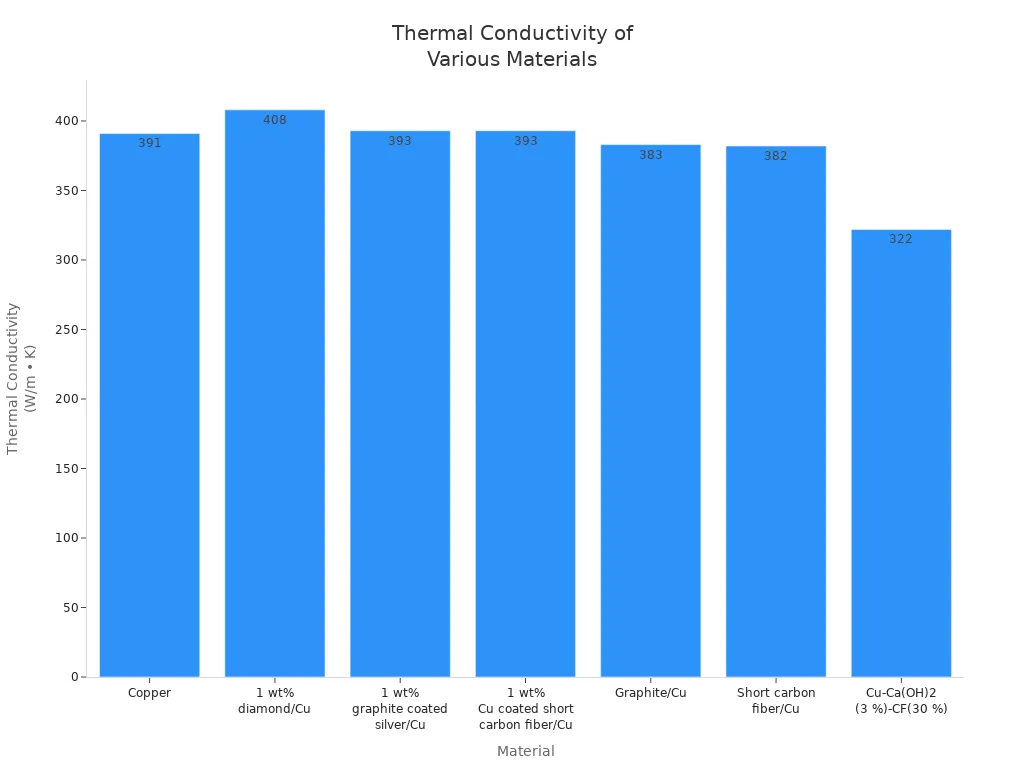
Copper and aluminum have higher thermal conductivity than carbon fiber. But carbon fiber can reach high values if used in the right direction. Carbon fiber composites are anisotropic. This means their thermal conductivity changes with fiber direction. You can design parts to move heat where you want.
DASEN carbon fiber gives you more than strength and light weight. Its thermal conductivity can reach up to 200 W/mK. This helps devices get rid of heat quickly. Electronics stay cool and last longer. You can use DASEN carbon fiber in electronics, energy, and transportation. The table below shows some main advantages:
Advantage | Description |
|---|---|
Lightweight | Carbon fiber products reduce the weight of devices, enhancing portability. |
Thermal conductivity | Capable of reaching thermal conductivity up to 200 W/mK, aiding in heat dissipation. |
Improved device longevity | Helps in maintaining optimal temperatures, leading to longer life for electronics. |
Reduced downtime | Efficient thermal management minimizes operational interruptions. |
Tip: Using DASEN carbon fiber helps your products stay cool. They work better and last longer. Your products also become lighter, which is good for modern technology.
You can trust DASEN’s production for steady thermal conductivity. Your products will perform well even in tough conditions. DASEN carbon fiber helps you manage heat in smart ways.
It is important to know why dimensional stability matters in engineering. The carbon fiber coefficient of thermal expansion shows how much a material changes size when it gets hotter or colder. Carbon fiber almost keeps the same size, even if the temperature changes a lot. This helps you make products that do not change shape or size. You can count on carbon fiber to stay steady in hard places.
Low thermal expansion is very important for high-precision engineering. It makes sure parts keep their size, even when temperatures go up or down. In fields like space and electronics, being exact is very important. Even small changes in size can cause big problems.
You see carbon fiber in electronics, medical tools, and energy products. These things need to work right every time. Dimensional stability helps stop mistakes and keeps your devices working well.
Carbon fiber acts differently based on how the fibers are placed. You can control how much it expands in two ways:
In- expansion happens along the fibers. Carbon fiber expands very little here. Sometimes, it even gets a bit smaller when heated, which is not common for most materials.
Through-thickness expansion happens across the layers. Expansion is bigger in this way because the resin does not stop heat as well as the fibers.
You can design your product to use these features. If you want a part to stay steady, you put the fibers in the best direction. This helps you control how much your product changes size with heat.
Here is a simple comparison:
Expansion Type | Behavior in Carbon Fiber | Engineering Impact |
|---|---|---|
In- | Very low or negative | Keeps parts stable and precise |
Through-thickness | Higher | Needs careful design and control |
You can use carbon fiber to make parts that stay strong and correct. This helps you build better products for tough jobs.
DASEN gives you great control over the carbon fiber coefficient of thermal expansion. You get materials that stay steady and work well. DASEN uses special ways to make sure your products do a good job:
The way you lay out the carbon fibers in CFRP is important for controlling thermal expansion and keeping the size the same.
Special ways of making, like cooling slowly and molding carefully, help lower stress inside and make the size more stable.
The kind of polymer matrix, like using special resin, helps keep the size right by stopping shrinking and thermal expansion.
Ways to protect the material, like coatings that keep out water and heat, keep CFRP safe from things that could change its size.
You get the benefit of DASEN’s strong quality checks. Every product meets high rules. You get steady thermal conductivity and low expansion. DASEN’s carbon fiber has a coefficient of thermal expansion about one-sixth as much as aluminum. Sometimes, carbon fiber even has a negative coefficient of thermal expansion, which is not normal for metals and polymers.
You can trust DASEN to give you materials that help your designs stay exact. DASEN’s carbon fiber keeps your products steady, even when it gets hotter or colder. This makes DASEN a good choice for high-performance engineering.
You can change how carbon fiber handles heat. This depends on fiber direction and matrix material. If fibers go one way, heat moves fast. If fibers go many ways, heat spreads slower. The matrix holds fibers together. It also affects how heat moves. Some matrix materials help heat move quickly. Others make heat move slowly.
Here is a table showing the main factors and their impact on thermal properties:
Factor | Impact on Thermal Properties |
|---|---|
Matrix Material | High impact on thermal conductivity and coefficient of thermal expansion |
Glass Transition Temperature | Variation does not change significantly compared to neat polymer |
Specific Heat Capacity | Variation does not change significantly compared to neat polymer |
Fiber Orientation | Important in determining material properties |
Matrix material and fiber direction are very important. If you pick the right matrix and line up fibers, you get better heat movement. You also control how much the material changes size.
Tip: You can make thermal conductivity higher. Use polyacrylonitrile-based carbon fibers. Make the matrix structure better. If fibers are lined up well, heat moves faster. This can reach up to 400 W/mK.
How you make carbon fiber composites matters a lot. The way you build them changes their thermal properties. Old methods use outside heat. This can waste energy and slow things down. New methods use electric heating. This saves energy and makes heat move better.
Automated ways like filament winding and tape layup help a lot. They make production faster and easier. These methods also make composites stronger and more reliable. If you use advanced manufacturing, you get better thermal conductivity. You also get steady performance.
Automated machines lower labor costs. They also make products better. These methods are important for many uses.
DASEN uses smart ways to make carbon fiber products. The company checks quality and uses new manufacturing ideas. You get products made by machines that keep fibers lined up. The matrix stays the same every time.
DASEN’s workshop uses new tools to watch every step. You get composites with high thermal conductivity and low expansion. Patented methods help you get good results in electronics, energy, and transportation.
You can trust DASEN to give you great carbon fiber products. Advanced processes make sure materials work well in tough places. DASEN’s skills help you build products that stay cool, strong, and steady.
Carbon fiber is used in many industries that need high performance. It handles heat very well. In race cars, engineers use carbon fiber to cover engine parts. This helps move heat away from the engine. The car runs better and lasts longer. In space, carbon fiber is used for parts that face heat and stress. The material keeps its shape and strength, even when temperatures change fast. In electrical systems, carbon fiber mixes with other materials to control heat. This makes it a smart choice for devices that must stay cool and safe.
Here are some industries that get the most from carbon fiber’s thermal properties:
Aerospace: Air parts use carbon fiber to handle heat and stay light.
Automotive: Race cars use carbon fiber to keep engines cool and efficient.
Electrical Applications: Carbon fiber works with insulation to manage heat in electronics.
DASEN gives you advanced carbon fiber products for electronics and energy. When you use DASEN’s carbon fiber, your devices lose heat quickly. This stops overheating and helps electronics last longer. DASEN’s carbon fiber plates and prepregs work well, even in tough places. You can use these materials in batteries, circuit boards, and power systems. DASEN checks quality to make sure you get good results every time.
Note: DASEN’s carbon fiber helps you build safer and more reliable products. You can trust these materials to keep your devices cool and steady.
You want materials that are light and strong. Carbon fiber gives you both. It weighs much less than metals but still handles heat and stress. This makes it great for s, cars, and buildings. When you use carbon fiber, your products are easier to move and use less energy. Carbon fiber’s thermal stability means parts do not change shape, even when it gets hot. This keeps your designs safe and working right.
Lightweight construction makes things work better and saves energy.
Thermal stability helps your products last longer and stay strong.
Engineers pick carbon fiber for projects where weight and heat control are important.
You can see how carbon fiber changes the way you design and build. It lets you make products that are light, strong, and ready for the future.
Carbon fiber is used in many electronics. It helps take heat away from important parts. Phones, tablets, and laptops use carbon fiber to keep chips cool. This makes devices last longer and work better. DASEN carbon fiber sheets fit inside small spaces. You can use them in circuit boards and battery packs. They spread heat fast and protect sensitive parts. Engineers pick carbon fiber because it is light and strong. You get safer electronics and better performance.
Note: Using carbon fiber in electronics stops overheating. Devices stay cool and work smoothly.
Carbon fiber is found in cars, trains, and s. It makes vehicles lighter and faster. DASEN carbon fiber tubes and plates build strong frames. They also help manage heat in engines and batteries. You can use carbon fiber for engine covers or battery cases. This keeps temperatures steady and improves safety. Racing teams pick carbon fiber for strength and heat control. Cars move faster and use less fuel.
Here is a table showing how carbon fiber helps in transportation:
Application | Benefit |
|---|---|
Engine covers | Moves heat away from engines |
Battery cases | Keeps batteries cool |
Body panels | Reduces weight |
Carbon fiber is used in medical tools and energy systems. Hospitals use carbon fiber for imaging machines. It keeps machines stable and safe. Doctors use carbon fiber for surgical tools because it does not change shape with heat. In energy devices, carbon fiber helps manage heat in batteries and solar panels. You get better energy storage and safer power systems. DASEN carbon fiber products support new technology in medicine and energy.
Medical imaging: Carbon fiber keeps machines steady.
Surgical tools: Carbon fiber stays strong and precise.
Energy storage: Carbon fiber helps batteries last longer.
Tip: DASEN carbon fiber gives you reliable medical and energy solutions. It helps your devices work well and stay safe.
New ideas are changing how we use carbon fiber for heat. DASEN is making better products to solve hard problems. As technology gets better, carbon fiber will do even more. Here are some cool trends:
New carbon fiber composite heating plates give you more control over heat. You can use these plates in things that need the right temperature.
Smart heating systems are now part of carbon fiber products. These systems let you change heat fast and keep things safe.
Saving energy and being green are important now. DASEN makes carbon fiber products that use less energy and last longer.
You get good results because DASEN works hard on new ideas. The company spends money on research to make better materials. You get products that work well and meet new rules. DASEN’s carbon fiber helps your projects by managing heat and saving energy.
Tip: DASEN’s carbon fiber helps you build smart and green devices. These new ideas help you stay ahead as things change fast.
Carbon fiber is used in more industries every year. The market grows as people find new ways to use it. You see carbon fiber in s, cars, and clean energy. The table below shows how these uses will grow:
Industry Application | Expected Growth | Key Factors |
|---|---|---|
Aerospace | Significant | Need for light materials and good heat control |
Automotive | Increasing | Using better heating solutions |
Renewable Energy | Expanding | Used in wind turbine blades for better results |
Carbon fiber is very important for clean energy. Wind turbine blades use carbon fiber to work better and weigh less. Money spent on wind energy will be over $1 billion by 2030. Recycling carbon fiber is also getting better. These changes grow by about 20% each year, making carbon fiber more eco-friendly.
The carbon fiber market will grow a lot. More companies want green materials and better recycling. These changes help you make lighter and stronger products that are good for the t.
The market for carbon fiber grows in clean energy, like wind turbines.
Recycling gets better, so carbon fiber is more eco-friendly.
You get new materials that help your devices work better and last longer.
Note: DASEN’s carbon fiber will help you meet future needs. These products work well in many industries and help you make better solutions.
You can see that carbon fiber is special in engineering. It handles heat well and stays steady. People use carbon fiber in s and cars. It works even when things get very hot. Carbon fiber does not expand much, so parts stay the same size. This helps stop stress and keeps things safe. DASEN makes new carbon fiber products. You can look at DASEN’s materials for heat control. Material science helps you make better technology every day.
Carbon fiber has different thermal properties than aluminum.
Carbon fiber works well when it gets hot.
Carbon fiber does not expand much, so parts stay stable.
You get a material that is strong, light, and handles heat well. Carbon fiber stands out because it keeps its shape and moves heat in special ways. Many industries use it for these reasons.
You can use carbon fiber to move heat away from important parts. It spreads heat quickly along its fibers. This helps keep devices cool and working longer.
You find carbon fiber in electronics, cars, s, and medical tools. It helps make products lighter and stronger. Many engineers choose it for high-performance projects.
You can use carbon fiber instead of metals when you need less weight and good heat control. It works well in places where metals might expand or get too hot.
You can trust carbon fiber in electronics. It does not conduct electricity like metals, so it helps protect sensitive parts. It also keeps devices cool and stable.
You can change the way carbon fiber handles heat by adjusting the fiber direction and the matrix material. This lets you design products for specific needs.
You get a material that resists heat and stress. Carbon fiber keeps its strength and shape over time. This makes it a good choice for products that need to last.